Gajendra Moksha – Part 2 : Indradyumna-Gajendra Attains Moksha

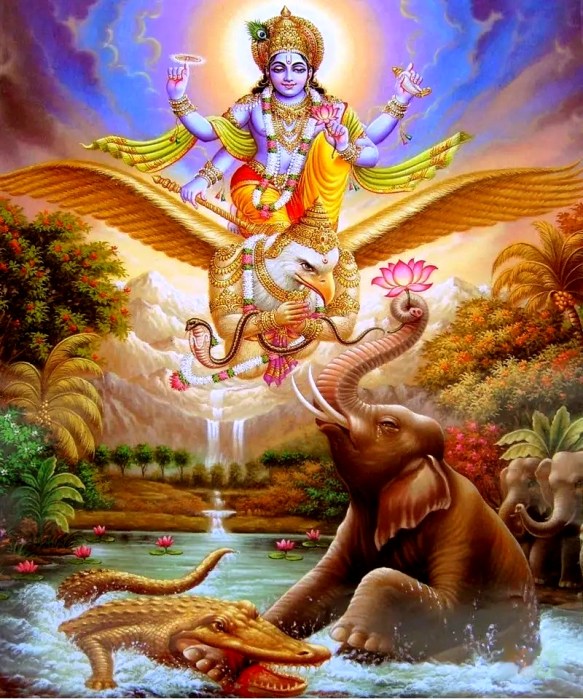
Vishnu rescues Gajendra

In the first part, we saw how the disciple Indradyumna’s (the lower self’s) consciousness gradually gravitates away from that of the higher Self and he was no longer apt to live in the the high spiritual realms. We will see in this second part how he strengthens his link with the Divine, and finally lives as the higher consciousness once more, thus reaching his spiritual goals.

Let us remember that everything happens in the inner world of the disciple Gajendra. The struggle to reach the Light and be wholly one with God happens in our consciousness. Maharajji (Shri Hans Raj Maharajji Sacha Baba) once said, “You will be rewarded according to your deeds. Now come to your senses. God will free you of your karma. He is not at all outside you. He is inside. Inside you there is hell, heaven and devaloka. Everything is inside. It does not make any difference if you are a Hindu or a Muslim.” [Prakash Diwash Message 3 Oct 2008]

There was once an elephant named Gajendra who lived in a garden called Ṛtumat, which was created by Varuna. This garden was located on Mount Trikuta, the “Three-Peaked Mountain”. Gajendra ruled over all the other elephants in the herd.

One day, as usual, he went to the lake nearby to pick lotus flowers to offer prayers to Vishnu. Suddenly, a crocodile, Makara, (or Huhu) living in the lake attacked him, and caught him by the leg. He tried for a long time to escape from the crocodile’s clutches. The whole herd, relatives, and friends gathered around to help him, but in vain. The crocodile simply would not let go. When they realised that ‘death’ had come close to Gajendra, they left him alone. He trumpeted in pain and helplessness until he was hoarse. As the struggle was seemingly endless, when he had spent his last drop of energy, Gajendra called on his deity Vishnu to save him, holding a lotus up in the air as an offering.

Hearing his devotee’s call and prayer, Vishnu rushed to the scene. As Gajendra sighted the god coming, he lifted the lotus with his trunk. Seeing this, Vishnu was pleased, and with his Sudharshana Chakra, he decapitated the crocodile.
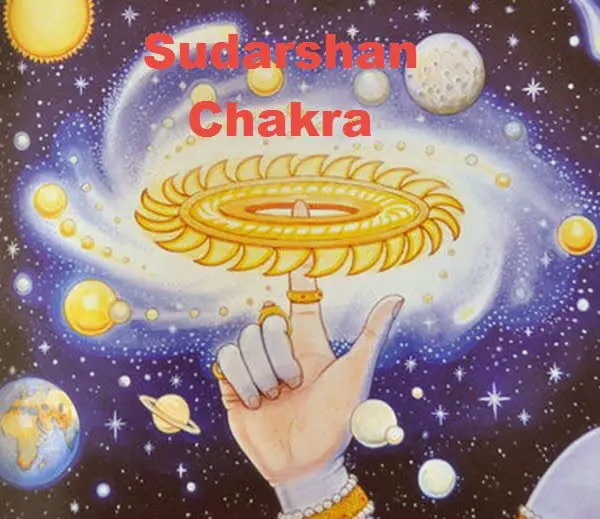
Gajendra prostrated himself before the deity. Vishnu informed him that he, in one of his previous births, had been the celebrated King Indradyumna, a Pandyan King (modern day Tamil Nadu) a devotee of Vishnu, but due to his disrespect to the great sage Agastya, he had been cursed to be reborn as an elephant. Because Indradyumna had been devoted to Vishnu, the deity had had him born as Gajendra. He made him understand the concept of Kaivalya, which was beyond Svarga (Indraloka) and Urdhva Loka, the realm of the gods. Indradyumna was to attain moksha when he (as Gajendra) left all his pride and doubt, and totally surrendered himself to Vishnu.

🔴 🔴 🔴🔴 🔴 🔴 🔴

Of course we will bear in mind that spiritual stories have several levels of meanings, and so there is no single interpretation. The symbols reveal themselves differently, even to the same person, depending (among other things) on their interest, sincerity and state of consciousness at a particular time. For example, the symbol of the “elephant” was not chosen by chance; different meanings will therefore be presented to the consciousness of different people. Our subconscious mind recognizes certain truths in these tales, and when solicited, will send up to the forefront of our thoughts specific ideas, not necessarily immediately, but over a period of time, more or less short…long.

Vishnu is God, Maintainer of all that is. Everything is contained in Him, and He is in everything. He is linked to the soul and consciousness. Vishnu is also the spark of God in man (usually known as Brahman according to the Upanishads) – the Atma, the higher Self, which was not created, is divine and eternal. The Atma – God in man – remains in God and can never leave.

▪︎ Manas (the Mind, Intelligence) is the thinker, the actor, and the creator and experiencer of Karma. The lower manas is our present personality, our personal (lower) self, while the higher Manas is our permanent individuality, our individual self belonging to the divine world. This higher Mind, as part of the essence of the Universal Mind, is unconditionally omniscient.

▪︎ In the tale, Varuna, the higher Manas is never mentioned, except when we are told that Gajendra, the disciple, lives in a garden created by Him. So we easily understand that he is under His direct rule. The disciple does not know Him, he only knows Vishnu, the Atma. However, Varuna is his higher Mind, his “better half”, and little by little, He communicates His love and wisdom to Him. Whenever Gajendra, the lower mind raises his consciousness, he may remember some of what filters down to him as intuitive thoughts, premonitions, “vague undefined reminisciences”, visions etc;

▪︎ In reality, there is only one Manas, which is a part of the Divine triad in Man, the higher consciousness, along with Atma (the higher Self – universal) and Buddhi, (His vehicle – Universal Soul), all three of which are eternal. But since its vibrational frequency is of such a high nature that it is impossible for it to incarnate, function, or manifest directly here on the physical plane, it functions there as the lower manas or mind. There is practically no communication between them, because of the great difference in the frequency on which they function.

▪︎ Just as the deva (angel) Varuna of the divine world comes just after God (Shiva, Vishnu, Brahma) in the hierarchy of divine beings, as one of the seven sons of Aditi – the Great Architects of the Universe (or in Christianity the seven Spirits before the throne of God – Archangels) who watch over humanity, in the same way in Man the divine higher Manas, Mind, comes just after God, (Atma-Buddhi), and is in charge of the lower self.
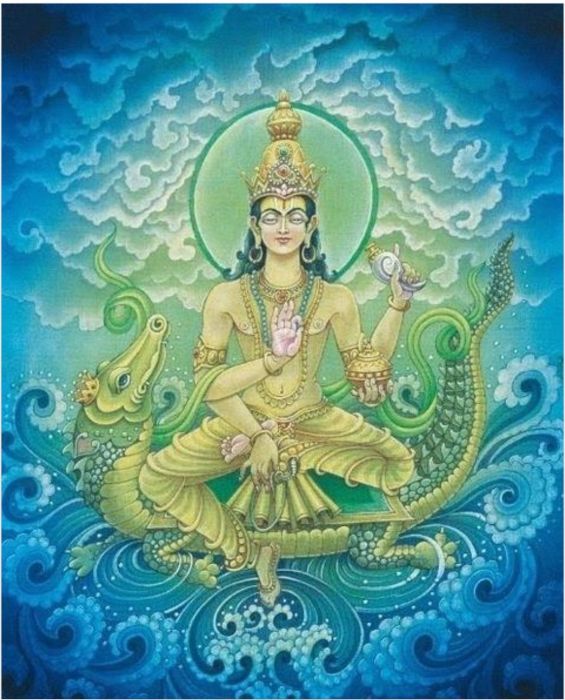
Varuna, god of oceans, water and sky seated on Makara, his mount

▪︎ Varuna is stated to be the god of the western quarter of our world and universe, but this quarter is founded on water and dependent ultimately on the heart and the fire of soul. He is in charge of the inner world and spiritual development. Similarly, the higher Mind is in charge of the inner world where the lower self evolves. He is the human Soul, and shines down on the lower self like the sun. Varuna is associated with the higher spheres – the western sky and the western portion of the universe, but also with the night, oceans and water which symbolise the moving consciousness of the lower self – sometimes going up towards the Light, the Atma (the dynamic ocean), sometimes down towards to the still (dead) waters of desire, in the material world of maya – the pond or lake.

▪︎ Varuna is also the Lord of Ṛta (justice) and Truth, ie. one of the four great Karmic deities placed at the four cardinal points to watch over mankind. He sees to it that God’s law – the law of karma is carried out. In the same way, the higher Mind is in charge of carrying out this law: it stores all good deeds and thoughts permanently, since they contribute to the spiritual development of consciousness. The seeds of karma (good and bad) from thoughts and deeds are kept by the higher Mind and are restored to the new lower self in each life, so you reap what you sow – there is no injustice.

▪︎ Just as Varuna helped Rama build a bridge to cross over to Lanka, He, as the higher Mind, can also help the lower self in the building of the bridge between them. However, it is the heart which makes this possible, through the growth of consciousness.

▪︎ The Sudarshana Chakra is a special weapon used by Lord Vishnu. It is a spinning, disc-like weapon and has 108 serrated edges. The Heart Chakra is believed to have 108 focal energy lines that extend from the chest (where the Heart Chakra is located) outwards to fill our entire being.

▪︎ So the Sudarshana Chakra is disc-like and spins, like the chakras of the body. In ancient scriptures the centre of the heart was called the crossroad (of energies), and was represented by an equilateral cross. All energies from the Higher consciousness and the Higher world go through the heart to the lower self; all prayers and communication from the lower self to the Higher consciousness, and Higher world go through the heart. The double dorje, like the swastika, indicated the rotation of the heart’s fire. Rotation and equilaterality are the signs of balance.

▪︎ Like the heart, this weapon is wise, and sure, as its name indicates – in fact, the literal meaning of Sudarshana Chakra is “one that has auspicious vision.” Once it is released, the Sudarshana Chakra annihilates the enemy and returns to the one who wielded it. Even after its release, the Sudarshana Chakra remains in complete control of the one who had wielded it, like the heart.

▪︎ The Sudarshana Chakra has the power to destroy anything in its path. So does a spiritually developped heart.

▪︎ It is not thrown, but with willpower it is sent against the enemy. This is because, as the Bhagavad Gita tells us, our enemies are different features of the lower self which tend to keep us bogged down in the material world. In the same way the heart cuts away all negativity as one advances along the Path. Here willpower is needed, and that is why in another tale, Vishnu solicits Shiva’s help to obtain the suitable weapon to defeat the weaknesses of the lower self, for Shiva has great willpower, and He is given the Sudarshana Chakra. The heart also gets its willpower from the Atma as the disciple develops.

▪︎ Trikuta is one of the twenty mountains surrounding Maha Meru (Mount Meru) the home of Brahma. As Brahma created the world, He is in it, and everything is in Him. This symbolizes the fact that Gajendra the disciple is now in the ordinary world, he is no longer in the divine realm, the spiritual paradise with God. To find that realm he has to climb up the mountain to where the gods live. His lower consciousness is now at home in the everyday life of the world.

It is the world of maya because although he is living the life of the lower self, in reality he is the Atma or the higher Self projected into the world of Man. The only reality for him, therefore, is the reality of the Atma, and not that of the lower self.

What is expected of him is to allow himself to be guided by the spiritual impulsions from his higher consciousness by living through the heart, which will steer him through all the necessary experiences, and then make him live permanently as the higher Self or Atma. The Atma will then be able to fully function as God in Man – with a suitable body, or without one, according to the circumstances.

As an example, we can take the case of well-known Masters like Rama and Krishna who, after having realized their True nature long, long ago, come back to Earth through Avatars (who are necessarily Realized beings themselves) whenever necessary, to do God’s work. And today, more and more we come to know of Realized people who, having obtained eternal life through Self / God realization not very long ago, choose to reincarnate to carry out some particular task. There are more people in this case than one would imagine.

▪︎ The Trikuta mountain is believed to be the second home of the goddess Durga. In three different forms, she fought a spiritual battle there to put an end to evil on the earth, and that battle has still not ended. It is on this mountain that Gajendra will fight his own battle, a fitting place.

▪︎ The three peaks symbolize three steps up the ladder of initiation, or three important stages he will go through on the Path back to God.

▪︎ The mountain has not only a high spiritual realm with three peaks, but also gardens with lakes and animals. The Rtumat garden was created by Varuna (higher Mind) in his role as Lord of Karma and it is adapted to the karmic situation Gajandra (lower self) finds himself in. It symbolizes the material world or kshetra – the “field” referring to the lower consciousness, or lower self; for just as God is the Knower of the field (the world, His playground), in the same way the higher consciousness is the knower of the field (the lower self). In Trikuta, Gajendra, the lower mind, has the choice, for example, to climb the mountains of spirituality and see himself as the knower, or descend to the lakes of illusion and go to the muddy waters of egoism and pleasure through the senses. To avoid the dangers inherent in the life of the lower self, he needs the wisdom of the heart, leading to more light from the soul.

The disciple can win the battle only if he sees himself as the master of the field, one who knows it, and so knows how to proceed, with determination.

(or pond) symbolizes the sea of emotions in which we constantly bathe, that constantly pushes our consciousness from one extreme to the other: sad / happy, etc., but which can be transmuted into spiritual love, the energy of love; and the material world with all its egoism and sensual pleasures – i.e. getting pleasure from the physical world and taking the time to indulge in the senses, which hold us captive and bind us in the waters of samsara (perpetual death-rebirth). It is this “field” of desire that the lower self, by seeing itself as the higher consciousness, will have to overcome.

symbolizes an intelligent and spiritual person, well respected and loved by the community. However, his huge cumbersome animal body tells us that he is no longer adapted to “heavenly” life. Gajendra, the lower self will have to refine his physical and subtle bodies through regular sadhana (spiritual practice), adapted to the goals he has in sight. This is, for example, necessary in order to hear the whispers of the Soul.

that he is in charge of symbolises different features of the lower self which need to be canalized, “trained” to go in the right direction and follow the path that he leads them on. These features will fall into line when certain spiritual habits are well established. For example, Ma Anandamayi recommends “a fixed time for prayer or meditation for all members of the family including the servants. If this practice is continued for long, divine contemplation will become a part of your nature. Once the habit is established, the future course of your life will be made quite easy. You will feel the flow of the mysterious Divine Grace feeding all your thoughts and giving you new strength.”

That is why Lord Krishna tells the disciple Arjuna how important it is to know himself to be the “knower” (the higher consciousness) of the lower self (the field) so he can win the struggle in the spiritual war between wisdom and ignorance, the psychological combat between higher intelligence and the lower mind, and the bodily war between self-control and harmful self-indulgence. “Know Myself to be the kshetrajna (knower of field) in all the kshetras (fields), O descendant of Bharata. It is the knowledge of kshetra and kshetrajna which I consider as the ultimate knowledge.” (Bhagavad Gita ch.13)

▪︎ These spiritual gains, produced in each lifetime are stored in the higher consciousness and they become “building blocks” in each life to consolidate the building of a new Man. That is why Gajendra, the lower self offers them to Vishnu. They are obtained by following the promptings of the heart, as symbolized by the lotus flower.

▪︎ It is Ahamkara, the I-making faculty of the lower self, the will to be separate, which is necessary for human evolution. However, it must remain subordinate to the will of the higher Mind, which knows itself to be a part of the Universal Mind, where only Unity reigns – everything is connected. This faculty also allows the consciousness to go upwards to the higher Self or down to the materialistic world — the pond or lake of egoism and desire.

🔴 🔴 🔴🔴 🔴 🔴 🔴

After having lived in the heavenly realms, where he was guided by his higher Self, the disciple now finds himself in an inferior situation. He has allowed his consciousness to gravitate towards a very materialistic way of life and as a result, he is now more influenced by the lower mind than the higher one. Maya has made his life as the lower self so real that he is happy with his situation. However, his task in this life is to strengthen his link with the Divine, and live as the higher Self once more so as to reach his spiritual goals. The immortal destiny of each and all of us is to live with the consciousness of the higher Self.

Fortunately, although the influence of the Atma has greatly diminished, the disciple still hears, more and more, the little voice of conscience from his heart, as he reflects on the life he is living. While the thread from the Atma had always been there, there had been no need to build it, the thread between the two minds has to be built by the lower manas. All his lotuses contribute to building this canal through which the two minds can communicate, and to get them, he has to live through his heart.
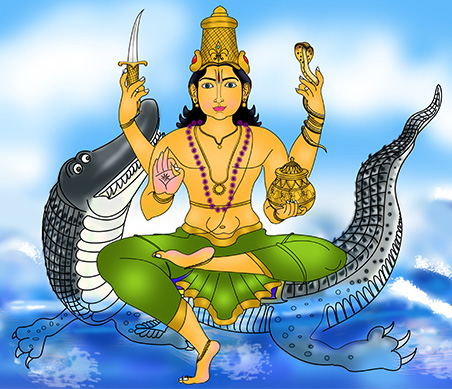
Lord Varuna holding a snake in his left rear hand of the four hands, which he uses as a noose to bind sinners (negative features of the lower self).

The thread which links the Soul to the personality will get thicker and thicker as he follows a sadhana. Indeed, all the good thoughts, words and deeds from all his past and present lives are stored by the Soul, which contribute to reinforcing the link between the two selves. Through it, Gajendra will begin to register the Soul’s wisdom as it subtly shapes thoughts within his mind.

This link is the beginning of a canal or bridge between the Soul and the lower mind. Gajendra does not know, but when the first strand of the bridge was built, it meant that he had taken his first step on the Path.

It has been said that to find the Path one must become the Path. This is a profound notion, and directly relates to the subject at hand. Often people believe that the spiritual Path is related to the things we do and the directional choices we make in life. The Path is not a journey based upon doing, but rather upon being. It is not governed by personality driven activity, but by an urge to be the authentic-self, filled with love and guided by wisdom and higher purpose from the heart. In truth, the Path is an inner journey leading to the Soul. This, Gajendra will learn the hard way.

The fact that he keeps on going to the lake shows a lack of spiritual aspiration, for that means he likes the worldly life he finds there, which makes him happy; he does not seem to go up to the mountains, to spirituality. However, the disciple does do some good deeds, for he always has flowers to offer Vishnu. But this is not enough to help him out of his situation.

The disciple tells himself that the lake is beautiful, and so he must enjoy it, and he does. However in several versions of the tale, after having been told that the disciple had gone to a lake, at the end, after the disaster, we are told that it was a muddy pond, after all. But that shows a lack of discernment because he has not learnt enough lessons from his past lives to allow him to avoid certain things which are dangerous for his spiritual life. He will have to learn the hard way that all that glitters is not gold.

The fact is that with the veil of maya enveloping his consciousness he does not feel that there is a problem and so does not try to change; he does not remember his past lives as a highly spiritual person, close to God. However, in Varuna’s garden, the law of karma has to be applied, and so circumstances will arise to open the disciple’s eyes to his situation. It is the disciple himself who creates these circumstances by his actions, and not Varuna; the law of karma simply applies to the disciple that which he himself had created before.

At the beginning of this episode, we see that the disciple is submerged by his lower self dominated by maya. He is at the mercy of certain features of this self which may sweep him into inertia, spiritual blindness or bondage, or all three. He is losing the battle between wisdom and ignorance, and maybe also between self control and harmful self-indulgence. He does not remember that in reality he is divine, and should live as the higher Self, as was intended, and we see no signs that he follows a regular sadhana. He does not follow the little voice of conscience.

Then one day, due to his lack of regular sadhana, this worldly living creates a disaster in the disciple’s life. He is caught by bad habits of the lower self, in thinking or behaviour which paralyse, bind him. This had been going on for so long, that they have now overwhelmed him.

Although he tries and tries to get out of that situation, he is held fast. It had taken this situation several lives to come about, as his consciousness had bathed constantly in the waters of desire. Gajendra remains a hostage of those bad habits for a long time, constantly suffering, without applying any of the spiritual teachings or mantras he used to know.
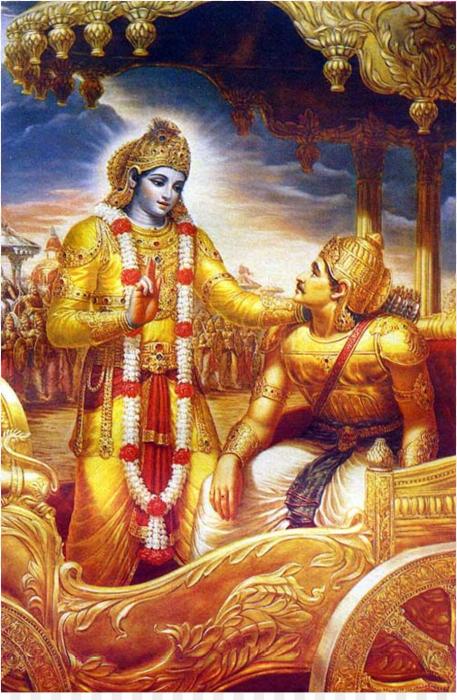
Krishna tells Arjuna: Fix but thy mind on Me, and by My grace thou shalt overcome the obstacles in thy path.

Varuna, the Soul constantly speaks to Gajendra, but he does not perceive this. But little by little, his heart makes him remember a mantra he used to chant, the name of God. He finds himself chanting it, more and more as time goes by. He notices that he feels less pain when he chants it constantly, but the pain comes back when he stops.

Then parts of the Bhagavad Gita would come to mind, like this one:

He particularly liked this one, for it seemed to him that it was speaking directly to him. These words were constantly in his mind, and they became a part of him. They brought hope and peace. He would often close his eyes and imagine himself face to face with Vishnu, and His image stayed in his mind all day. He found himself meditating often, then regularly. It felt so good to bathe in such high vibrations that he didn’t feel the crocodile’s bite as much as before.

Since God dwells in his heart, then he could reach Him through prayer, or even just talk to him like a friend. Gajendra often talked to Him, and expressed gratitude. He also prayed for the well-being of others around him, and thanked God for all he had given to the beings on the Earth. He was beginning to live through the heart. He was in a beautiful garden, and he tried to imagine what the mountains were like, and sometimes dreamt that he climbed up to the summit.

Guided by his heart, he slowly got to know himself, he understood his weaknesses better and better. With time, he was no longer frightened by his situation, and he decided to fight the battle and overcome these weaknesses. As he had all the time in the world to think, he often reflected on passages from the holy scriptures, symbolic stories he used to read, and even the ordinary events of his daily life. It seemed to him that everything that had happened to him held a lesson for him to learn, and he would reflect on them. He now understood the usefulness of meditating, selfless service, the right thinking, and self-control, with the help of the heart. He never stopped chanting the name of God and he kept his mind in a constant state of meditation. He always saw himself with Vishnu in Vishnuloka (Vaikuntha).

The disciple was now able to understand his situation, for guided by the heart, the spiritual practices he had adopted strengthened the bridge between the Soul and the lower mind, thus enabling him to receive answers to his questioning, advice about things in his everyday life, and explanations about many spiritual concepts. More and more light was coming down from the Soul, and his knowledge became wisdom. He understood that only Vishnu could save him from spiritual death, which was threatening him. He surrendered to Him.

The Soul, seeing that the lower self was seriously building a bridge in His direction, started building the other end of the bridge. Yes, they were both working together. Then Makara was subdued.

From that day on, his heart exulted. His consciousness had become transformed little by little, and now he was much different from the Gajendra he used to be. It was not only his thoughts which had become refined, but also his physical and subtle bodies. He continued his sadhana and it made him happy, he did not feel time pass as he constantly prayed to Vishnu and chanted His name.

One day, he wondered what the herd was doing, and he immediately knew in his heart that they were walking in the woods. He now possessed a small part of Varuna’s vast knowledge and wisdom ! It had inundated his consciousness and enlightened it !

Indeed, the bridge was finished, he was now once more in the divine world. All the prayers and meditation he had done had invoked the energies of the higher Self (Vishnu), through the heart, which had sent enough willpower for the disciple to be steadfast in his sadhana, in his determination to reach God. This willpower, sent to the heart (sudarshana chakra) had cut all ties with the the lower self (Makara decapitated), as the bridge was completed. He had obtained Moksha (no rebirth is necessary).

In Part 1 the tale puts it this way:

[…] and with Vishnu’s help, Gajendra achievies moksha, or liberation from the cycle of birth and death [eternal life]. Gajendra then attaines a form like that of the deity (Sarupya Mukti) and goes to Vaikuntha with Vishnu. Vaikuntha, also called Vishnuloka is the abode of Vishnu. It is an “eternal heavenly realm”, and is the “divine imperishable world that is God’s abode”.

The tale also tells us that “He (Vishnu), made him understand the concept of Kaivalya, which was beyond Svarga (Indraloka) and Urdhva Loka, the realm of the gods.”

The Yogatattva Upanishad (16–18) reads,

Kaivalya is the very nature of the SELF, the supreme state (paramam padam). It is without parts and is stainless. It is Truth-Consciousness-Bliss (Sat-Chit-Ananda). it is devoid of birth, existence, destruction, recognition, and experience.

This means that with the help of Atma (Vishnu), he then climbed the other two peaks of the mountain and completely changed his consciousness. Gajendra was now a Divine Man with the consciousness of the Atma, God. He had realized the SELF, God. He would henceforth help God in His work.

We all know of realized Masters who are Gurus, but we know less of others who do other work. Some do both at the same time. Many realized souls have vowed to stay with Earth and work for the spiritual progress and well-being of ALL sentient beings. Whether incarnated or not, they continue to inspire humanity (which is One Body we share the same Universal Soul) to make the right choices as we go up the path of spirituality. The evolution of all four kingdoms (mineral, plant, animal and human) happens at the same time, and when humanity rises in the spiral of evolution, this helps the other kingdoms up the ladder also. (That is the reason behind ahimsa – not harming anything in God’s creation.) They also inspire humanity to care for these lower kingdoms.

Among us today, there are great incarnated beings, called by different names, like Masters, Masters of Wisdom, Cosmic Masters, Bodhisattvas, who discreetly give assistance to humanity. They have not left Earth, while others in the same category have, and carry out their work without being incarnated. As an example of a part of their work – at particular times, they may receive God’s energy from the planets and constellations and redistribute it to humanity as needed, as these energies may need to be toned down. Others work through Avatars for specific tasks. They know the different cycles through which humanity and the planet in general evolve, and when it is time, they prepare humanity as best they can to meet the requirements and more easily go through those changes which will come about. However, they cannot help humanity against their will, and they always follow God’s law. This is just a part of their work. We are very grateful for their assistance.

🔴 🔴 🔴🔴 🔴 🔴 🔴
Posted in Living Your Spirituality | Tagged , , , , , , , , , , , , , | Leave a comment

Gajendra Moksha – PART 1: Indradyumna’s Disgrace

This tale is about a disciple who finds himself in great spiritual difficulty, but succeeds in overcoming the obstacles. There are many versions of this story but they are quite similar. We are hardly given any details, but with the help of the symbolism made clear, we understand more easily the depths of his inner struggle to reach the light. We are told that spiritual stories have three meanings (Bhagavad Gita), or more, so we have tried to go beyond the apparent meaning to discover a deeper one. Our subconscious mind, which recognizes certain truths in these tales may present each person with different meanings to the symbols, depending (among other things) on their interest, sincerity and state of consciousness at a particular time. There is not One fixed meaning to them.

There are many tales in Hinduism about the relationship between Man and the Divinity, or about the disciple’s trials in life as he seeks to get close to the Divinity, and they give some advice on how to become one with God. However, if one does not understand the symbols used in these allegories, the truths remain superficial, and the inner meaning of these stories is not perceived.

The characters used are usually very well known (to Hindus), so that their qualities and weaknesses do not need to be explained in detail. That is why very often God (Shiva, Vishnu, Brahma, their Avatars and consorts), demi-gods, devas, important spiritual beings, even though they are almost always made to act like human beings, which we know they never do, play a prominent role. Sages, places, bodies of water (lakes, rivers, oceans) are also often used, along with well known animals which are chosen for their known characteristics, but also because they are used as symbols for spiritual truths.

In general, one can say that tales have always been used, ever since man existed, to show him these spiritual truths in a way that will be more easily perceived by the subconscious mind of the lower self, which will retain the symbols and images and associate them with those truths. And when the same characters – people, animals etc appear tale after tale, the reader / listener more easily sees himself in the same situation, or not, and his heart whispers to him, showing him the right path to take in each situation. Reflection on these stories is very good for developing the abstract mind, one of the pillars on the path to Enlightenment.

In this article, we will start the study of the story Gajendra Moksha, and try to find out the deep meaning of the tale. We will set out the symbols and their meaning, then explain the story according to the deep symbolism found. The study will be in two parts : Gajendra Moksha – Part 1: Indradyumna’s Disgrace, and Gajendra Moksha – Part 2 : Indradyumna-Gajendra Attains Moksha.

🔴 🔴 🔴🔴 🔴 🔴 🔴

Gajendra Mokṣaḥ or The Liberation of Gajendra is a Puranic legend from the 8th Skandha of the Bhāgavata Purāṇa, a sacred text in Hinduism. It is one of the famous exploits of the preserver deity, Vishnu.

In this episode, Vishnu comes down to Earth to protect Gajendra, the elephant, from the clutches of a crocodile, alternatively known as Makara or Huhu, and with Vishnu’s help, Gajendra achievies moksha, or liberation from the cycle of birth and death [eternal life]. Gajendra then attaines a form like that of the deity (Sarupya Mukti) and goes to Vaikuntha with Vishnu. Vaikuntha, also called Vishnuloka is the abode of Vishnu. It is an “eternal heavenly realm”, and is the “divine imperishable world that is God’s abode”.

Gajendra, in his previous life, had been Indradyumna, a great king who was devoted to Vishnu. One day, Agastya, a great rishi (sage) came to visit the king, but Indradyumna remained seated, refusing to rise to receive the sage with due respect. Agastya was irate and noticed that the mighty king, despite the greatness of his good deeds, still had traces of ahamkara, or egoism, and he revealed to the king that, in his next birth, he would be born as an elephant, and in that form he would learn the hard way that the lower self must be renounced and surrendered to God. SymbolismThe tale of Gajendra is an integral theme in Vaishnavism and has great symbolic value: Gajendra is Man, the crocodile is sin, and the muddy water of the lake is Saṃsāra (almost unending cycle of death and rebirth). The symbolic meaning of Gajendra Moksha is that materialistic desires, ignorance, and sins create an endless chain of karma in this world and are similar to a crocodile preying upon a helpless elephant stuck in a muddy pond. Humans are thus stuck in a continuous cycle of death and rebirth until the day when they can look beyond everything in this creation and ultimately submit themselves to the supreme being, Vishnu. (Adapted from Gajendra Moksha. Read the rest of the tale here)

🔴 🔴 🔴🔴 🔴 🔴 🔴

The Symbols

Although he does not realize it, Indradyumna, as the lower self is closely connected to Vishnu the higher Self – God in man. In fact, he is one with the Atma, he is the Atma “made flesh”. He is meant to live in the higher spheres, as his status as a king indicates, as well as the meaning of his name: “One with the splendour like that of Indra”.

His free will allows him to keep his consciousness on the higher planes, or let it descend to the easy life of a materialistic world. It is this battle that the disciple has to win in order to understand that he is one with his Father, the Atma, and that his purpose is to serve Him; he will find no peace until he lives as He directs him to.

● Agastya, the Thread of Light

▪︎ He plays the role of the Thread of Light which the Atma uses, through the Universal Soul (Buddhi) to vivify and guide his shadow or son, from the highest level of consciousness to the low planes of the shadow in the physical world.

▪︎ He also represents the higher planes of consciousness in general.

▪︎ Agastya carries all the impulses and messages from the higher consciousness down to the lower self; Indradyumna feels and hears them through the little voice of conscience in his heart. He can choose to follow them or ignore them.

🔴 🔴 🔴🔴 🔴 🔴 🔴

We notice that the disciple of Vishnu, King Indradyumna is in a very comfortable position and is happy in life. This means that he is spiritually rich.

The initial situation is one of a disciple on the path, and at this stage, he is one with the Atma. As the lower self, or the lower mind, he rules over his subjects such as his five senses and his different states of consciousness where he can turn his mind upwards towards a high state of consciousness through love, kind thoughts, sharing, selfless works etc., or he can follow the easier downward path of a purely materialistic life of selfish behaviour, ephemeral pleasures and seeing himself as separate from other beings. The capacity to choose between the two worlds is conferred to him through the element Makara in Man.

He is considered a good disciple for he is devoted to God, and is known for the greatness of his good deeds. His consciousness remains on the higher planes of his being. This allows him to continue to benefit from the divine Light and guidance of his higher Self, his Atma (God, God in Man) symbolized by Vishnu, which comes directly to him through Agastya, the divine Thread which the Atma uses to guide him.

Since God, his father comes directly to the disciple, through the Thread, there is no need for pilgrimages or any sacrifices to get God’s favour. Divine blessings automatically flow freely down to the lower self, Indradyumna. This divine river flows freely down to the lower self because the Atma had the latter created to do specific work for it. All the disciple has to do is to keep his mind on God and the higher spheres while living his daily life, follow a simple sadhana and follow the impulses he gets in return. In that way the canal between the two selves remains open.

This is the state of Man when he is in his early development and is still mostly a spiritual being in which duality has not yet greatly developed and the fight between the higher Self and the lower one has not gone very far; it is still to the advantage of the Atma. Indeed, the body in which the Atma’s Thread is housed is still simple and spiritual, with not too much matter, which allows God’s spiritual energy to flow freely throughout his being. The disciple’s consciousness therefore remains naturally in the heavenly realms (connected to the Atma). He is in a sort of spiritual paradise.

Through the similarity of the names Indra, Indradyumna, and Indraloka we sense the deep connection between the lower self and the divine world. Indeed, The lower self is just a projection of the higher Self on a lower plane. He is spiritually in the divine world, but his lower mind tells him the opposite; however the more he turns his mind to the heights of spirituality, the more the divine world becomes real and normal.

But this situation changes dramatically when the disciple shows great disrespect for the usual instructions and advice (spiritual nourishment) coming from his higher consciousness through Agastya, the divine Thread. The disciple does not react as he should. When he feeels the impulsions from his higher consciousness, he sometimes ignores them, or doubts that it is the voice of God that he hears. Finally he no longer sees or feels the light coming from the Thread, and so does not follow the instructions given. He is blinded by the development of maya which accompanies the development of the lower self. The term maya has been translated as ‘illusion,’ but then it does not concern normal illusion. Maya means that the world is not as it seems; the world that one experiences is misleading as far as its true nature is concerned. Our true nature is that of the Atma, which is Truth-Consciousness-Bliss.

So, unfortunately, as time had gone by, after many, many, many lives the influence of the Atma’s Thread had become covered by the thicker and thicker layers of the lower self’s bodies as they became more and more complex; and also the development of the five senses, not connected to the higher Self, had caused the disciple’s lower self to live in a new artificial world of maya where the pursuit of artificial happiness, selfishly, had became the aim of life. Ahamkara, the I-making faculty in Man conferred by Makara had become too strong and had taken over. And Agastya did not fail to notice these traces of egoism – the will to be separate.

Progressively, the king felt less and less the influence of the Thread, but did not react enough. Although he loved Vishnu he did not use his spiritual faculties to push his consciousness upwards, but focused his attention on what the lower self found important, and lost his good spiritual habits; he was, perhaps, satisfied with doing a quick prayer from time to time, and going to the temple for the usual festivals. But unfortunately this was not enough, and so as nothing remains static, his consciousness gradually went downwards to a more materialistic way of life. His devotion to Lord Vishnu diminished without him even noticing. That is why, one day, the disciple did not even bother to react to the presence of the Atma’s Thread, Agastya. He no longer recognized the divine impulsions as something important; he was separated from the guiding influence of the Atma – God in Man.

According to God’s law, the law of karma, the disciple had prepared his next life through his thoughts and deeds, and so king Indradyumna has to live accordingly. His vibrations have become far too low for him to remain in a high spiritual sphere. His consciousness is no longer apt to receive the high vibrations of the spiritual energies from the higher Self. By his own behaviour, he has made it impossible for the Atma to guide him, and equally impossible for him to continue to benefit from the blessings that the Atma generally bestows on one who is connected.

Now receiving very little guidance from the Atma, the lower self then has to build a path back to his higher consciousness through a life of trials and suffering. He has to learn the hard way that the lower self is not independent, and that its destiny is to provide the path that the lower consciousness will take to meet the higher consciousness, and to see to it that the bridge between the two is built, otherwise he will live lives of suffering through endless cycles of death-rebirth (samsara).

So in his next life he will find himself in a situation created by only himself, where the circumstances of his new life will be adapted to the world he has created in his lower consciousness.

He will have the help of his heart and the higher Mind, the higher Manas which, with the Atma and Buddhi form the higher consciousness. From time to time he used to get inspiring flashes from this Mind, but that was when he liked to think about God and would often read the holy scriptures, like the Bhagavad Gita. Of late, he had not had any inspiring thoughts, but necessity is the mother of invention, so he will find the path back home.
(Continued in Part 2)

🔴 🔴 🔴🔴 🔴 🔴 🔴

Posted in Living Your Spirituality | Tagged , , , , , , , , , , | Leave a comment

The Faculty of Discernment


One should note that the so-called gift of discernment is no gift at all but the result of labour and experience. One can acquire it not through intuition but through many accumulations. To assert that discernment has no particular cause is like insisting that imagination is not a reflection of previous experiences.

The time has come for that which seems to be extremely abstract to enter into the chain of events. Human beings have gone through many situations and have thereby refined their ability to judge, by perceiving through the heart.

The human heart is not young, for its substance is permanent. Some will rejoice in this permanence; in this understanding lies eternal life.

Some will rejoice that a person’s consciousness is also his own responsibility.

That is how the Tablets of Truth become part of life. Do not tire of reading the Teaching of Life as it has appeared over all the ages. The open heart will rejoice in the alternation of rhythm. And with these foundations in place, we shall understand that the motion leading humanity onward cannot be seen in everyday life. In accepting this vast scope, let us also find a path to joy. (Heart)

🟢🟢🟢🟢🟢🟢🟢

Posted in Treasure Box | Leave a comment

Paramahansa Yogananda’s Message on Christ Consciousness

Paramahansa Yogananda on Christ Consciousness

By Paramahansa Yogananda

Written from India in 1935, shortly after his visit to the Holy Land, to all students and friends of Self-Realization Fellowship.

From Jerusalem and India, reinforced by the perception of the Great Ones, I bring unto you a new message of Spirit. Blessed is my soul to be thus an instrument of the Divine.

The pen of thought writes on the dark page of ether and makes the Spirit-Truth invisibly visible, and my fountain pen makes the unseen thoughts visible. So on this page I am painting God—with ink, thoughts, and Self-realization—that all may behold His glory.

As Truth peeps through the window of thoughts and words, so God manifests through Christ Intelligence and vibratory creation. When the beads of nations are not held together by the thread of universal perception of Christ Consciousness, of Christ Peace, they fall apart, knocking and scattering on the rocks of selfishness. The Christ of Christmas must be celebrated in the hearts’ love of all races for one another.

I pray Christ be born in the cradle of a new international understanding; that out of the dark night of war, the star of Christ Love may illumine a new United World. I pray Christ be born in all nations as love of unity, in all men as spiritual ambition, in true friends as the Divine Friend, in students of this path as Self-realization, and in all deep devotees as eternal, ever new Joy and perpetual Wisdom.

Earth-bound possessions and glory all fade away, but God-bound possessions hold through eternity, serving with supreme usefulness. Why worship material comfort on the altar of change? Learn to adore spiritual comfort in the temple of indestructibility. The best way to convert earthly accumulations into imperishable heavenly treasure is to use them for spiritual service. Christ must be lived to be known. In all good actions, in every material and spiritual service, and in the manger of meditation, the immortal Cosmic Christ is born anew.

None can know about that Christ by reading books on theology; one must feel his presence in the bower of deep meditation. In the cradle of meditation-tuned thoughts, woven with tender twigs of devotion, behold the newborn Christ, lulled by the cooing dove of inner peace.

In these twenty centuries Christmas has been celebrated 1,935 times—yet how few have realized the true significance of the birth of Jesus! Every year, God and the angels recognize this occasion with celestial celebrations for the good of all. So let each one of you, by prior weeks of deep meditation, prepare his consciousness to celebrate this coming Christmas. The arrival of the newborn Christ Consciousness in the hamlet of your meditation will be indescribably fascinating, uplifting, and expanding to your soul. Prepare for Christ by decorating the spinal Christmas tree(1) of your meditating consciousness with many new perceptions of the divine Christ, with ever-twinkling stars of wisdom and lotus blossoms of divine love. At the foot of this inner Christmas tree lay all your material desires, to be presented once and forever to the Christ Joy within you.

Then, on awakening Christmas morn, Christ will draw near the many-branched Christmas tree of your consciousness to receive your presents, and to give unto you his imperishable gifts of Omnipresence, Omniscience, Divine Love, Cosmic Light, Ever-Wakefulness, and Ever New Joy, bound with golden strings of eternity.

————————- –

(1) A reference to man’s seven cerebrospinal centers of spiritual intelligence and energy, manifesting as lights to the inner sight of deeply meditating devotees. In Hindu scriptures, these centers are often described as “lotuses”; in the Book of Revelation, St. John refers to their bright rays as “seven stars.”


Posted in Living Your Spirituality | Tagged , , , , , | Leave a comment

The Shield of My Name

Forsaking all other dharmas (duties), remember Me alone; I will free thee from all sins (Bhagavad Gita)

And so in labour will you meet Me.

But what are the signs of labour?

Speed, decisiveness, and self-sacrifice.

But with speed and decisiveness one may also rush
toward the abyss.

But your path is to the summits.

Therefore, add also wisdom.

Ask yourselves in the morning, beginning your day,

What you can add to the entrusted work

that My Name should permeate all your deeds,

And should enter not as obstacle but as affirmation;

Not averting, nor complicating,

but as a part of your decisive thoughts.

So labor wisely and, accepting the Shield of My Name,

You will conquer all that obstructs the ascent.

This is the advice for immediate application to the
work.

And so, precisely and simply I say:

Read and understand simply My Teaching,

without losing the given dates.

My Hand be with you.

(Leaves)

Posted in Treasure Box | Tagged | Leave a comment

Prakash Diwash or Enlightenment Day Celebration

On 3rd October 2023, the festival called Prakash Diwash or Enlightenment Day Festival will be celebrated at Sacha Dham ashram, Rishikesh in commemoration of Shri Hans Raj Maharajji’s enlightenment. Although he is no longer in his body, being a jivanmukta, he can never die, so he continues to inspire humanity, and pour down blessings upon all souls — even more so on special days like Prakash Diwash, as he has always done. The article below (2007), taken from his blog, explains what the festival is about, and shows us that we can still receive Maharajji’s blessings, wherever we are. Prakash Diwash especially reminds us that we also can follow in his footsteps and attain the Realization of the Self (Enlightenment).

Every year the festival called Prakash Diwash or Enlightenment Day Festival is celebrated at Sacha Dham to commemorate the spiritual enlightenment of our beloved Master Shri Hans Raj Maharajji which took place on 3rd October 1955. Surprisingly, he had arrived at the great Guru Sacha Baba’s ashram in Allahabad only the evening before.

How did he arrive there? At that time, Maharajji was working as an accountant in the Indian civil service in Allahabad. Unfortunately he developed a chronic form of dysentery which was exhausting and which resisted different treatments prescribed by doctors. This discouraged Maharajji so much that he did not know what to do to return to good health. Then, a fellow office worker, Swami Navalji, suggested he go and see Sacha Baba, a very great saint living in Allahabad, who would heal him. At that time, Maharajji had already moved away from religion, although as a child and a young man he had ardently desired to realize the Divinity, so great was his aspiration. It must be said that from a very young age he would often see Great Beings in his visions and dreams. But with time, this aspiration had progressively disappeared. He no longer believed in religion and saints.

However, having followed medical treatment in vain, he accepted his colleague’s offer, for after all, one never knows where the solution to a problem might come from. He therefore went to Sacha ashram in Arail, Allahabad, where he was received very kindly by the Master, Sacha Baba. [ In a dream 40 days before, he had seen a Saint who had told him he was his Master. He had given him a mantra and had told him to recite it continuously. Sacha Baba was the same saint in his dream ! ]

The latter gave him a room with all he needed for his stay at the ashram and recommended that he go and participate in a session of devotional songs which was going on. The following morning, Maharajji decided to meditate at dawn. It was during this meditation that an extraordinary mutation took place in his consciousness and his whole being, causing him to reach divine realization. He had come for his physical body to be healed, but he had received healing for his whole being! He had attained Self-realization. This was a marvellous event which became the turning point in his life and which, later on, would have profound effects on thousands of men throughout the world.

With time, Maharajji became progressively attached to Sacha Baba and he had only one aim : to help his Master awaken the consciousness and hearts of men to Wisdom, Love, Peace and the Beauty of God. In order to achieve this, he left his job as an accountant and abandoned everything in order to Serve God and his Master.

For several decades, Maharajji travelled throughout India to share his Master’s teachings with all those who he could reach. He completely forgot himself in this task. Little by little, disciples gathered around him and in 1974, Sacha Baba asked him to create his own ashram in Rishikesh, at the foot of the Himalayas: Sacha Dham or “The place of Ultimate Truth” (or “Holy Place”). Thus Sacha Dham was born, where Maharajji settled. Since then, he has always lived in Rishikesh and up until the time of Sacha Baba’s mahasamadhi (his leaving this world) in 1983, Maharajji, who has always nourished deep love for his Master, went to see him regularly. He has always said that he works in the name of God and that of Sacha Baba, and whatever he does, he attributes it to his Master, taking no personal merit, even when he works what men call miracles.

For those who have spent even a few days with Maharajji, the life of this great saint is an immense sacrifice made out of love for all men. His example, while evoking in each of us the greatest respect and the deepest veneration, remains a model from which we should draw inspiration for the good of all beings. Indeed, all beings are in fact ourselves, in spite our consciousness which has been muddled by ignorance, thus leading us believe that we are different and distinct from others.

The Prakash Diwash Festival is an opportunity to remind disciples that the aim of life is to achieve this divine realization, for with time, one becomes less vigilant and forgets one’s highest aspirations. Moreover, during this same festival where a puja (a highly significant religious ceremony) is celebrated, Maharajji gives special impetus to his disciples’ spiritual development by granting them certain specific energies which are usually grouped together under the term “blessings”, but all blessings do not have the same aim and the same impact. On Prakash Diwash day, enlightenment is given special importance! Many of his disciples come together at Sacha Dham to benefit from these unique moments of spiritual communion and deepen their ties with the Master. For those who are far away, it is always possible to share these moments with Maharajji and the assembly of his disciples by connecting inwardly with them, for we are taught that time and space do not really exist.

So on this special day, without neglecting his task of directing humanity towards a higher spiritual state, Maharajji devotes great attention to pouring blessings upon his disciples wherever they are in the world. It is true that Maharajji blesses his disciples all year long, but this day is a special one, and so special energy is transmitted. On this day, the channel between the Master and his disciples widens, and disciples who focus on Maharajji, opening their hearts even more to receive his blessings, will receive particular grace according to the efforts they have made in the past year to connect with the holy river (the Master), who purifies them like the holy Ganges purifies dirty water which flows into it.

Indeed, Maharajji has often said that the more one loves a true Master, the more easily one is purified, for the love one shows to him opens a canal through which the Master can work to take away negative things which keep us away from God, while transmitting positive energy to allow the divine spirit of God in us to manifest. Indeed, the Guru is God’s representative who He sends to guide disciples seeking more and more light. And since the aim of all disciples is to achieve union with God, it is the Guru who plays the role of intermediary between them and God. God has therefore given great power (the power of Shiva) to the Guru to cut away whatever is negative from the disciple’s personality and heart. He has also been endowed with the necessary shakti or spiritual power to make the disciple grow little by little into a great spiritual tree. This enlightened person will finally be able to communicate freely with the Divinity and in turn cooperate with God to help others return to the divine state which all men have to reach one day.

What is therefore important, is what happens in one’s heart throughout the year, and not just on Enlightenment Day. Knowing that it is the Guru who leads us from darkness to light, it is necessary to constantly focus our hearts on Maharajji throughout the year, while carrying out the specific sadhana he has recommended. Then we are sure that whatever particular blessing the Guru has to bestow on us, we will be able to receive all of it.

Disciples, of course, show deep gratitude to Maharajji for devoting his life to humanity and his pupils. Maharajji in turn, asks his disciples to pray for humanity, so that all may turn to God, and that hardship and even lives may be spared from disasters in the coming months and years. He also wants his disciples, through their prayers, to help humanity so that all their needs may be fulfilled. The Sacha lineage has seen to it that this can become reality; that progressively all hearts will turn towards God, and that the basic material necessities of all men will be met.

May Maharajji’s peace, love and light descend on us all !

Maharajji Mahaprabhu Ki Jay !

– ———————————-

Posted in Sacha Dham Ashram & Related, Shri Hans Raj Maharajji Sacha Baba & Related, Messages | Tagged , , | Leave a comment

Shri ShantiMayi: Living Through the Heart

ShantiMayi : vivre dans le coeur / Living Through the Heart

(In English and French)
Posted on 29 Jan. 2017

ShantiMayi, invited by Olivier Vinet to Nouvelle Conscience on Radio Ici et Maintenant 95.2 FM, speaks on different topics : healing the mind, living through the heart, transforming adversity into favourable conditions, the state of the world…

(ShantiMayi, invitée d’Olivier Vinet dans Nouvelle Conscience sur radio Ici et Maintenant 95.2 FM, aborde différents thèmes : guérir le mental, vivre dans le cœur, la transformation de l’individu, l’état du monde.. )

Posted in Living Your Spirituality, Shri Hans Raj Maharajji Sacha Baba & Related, Messages | Tagged | Leave a comment

Visit of Sacha Pandits From India 2023

Tripathiji with Shri Prajnaparamita at her ashram’s retreat centre, La Roseraie de Sacha

This year we were once again blessed with the visit of Pandits Tripathiji, with his son Pankaj, and Ashokji. Tripathiji and Ashokji had come to Europe in 2019 and had visited several Sacha ashrams and gatherings. This year they went to France, the Netherlands, the Czech Republic (16th July to 10th August) and Shri Prem Baba’s ashram in Brazil where they carried out ceremonies not only for the disciples, but also for the spiritual uplift of the world and world peace.

Screenshots from Summary of Sri Prem Baba’s teachings in 2023

Pujari Ashokji performing the Aarti ritual at the Shri Hans Raj Maharajji Mahasamadhi, 2013

Ashokji has been the priest (pujari) at Sacha Dham ashram for a long time now. Anitaji, Mataji (Mother) of the ashram shares some of those functions.

Tripathiji is from both Sacha Dham and Sachcha Ashram – the ashram of Maharajji’s Master Sacha Baba Kulanandaji. He had been with Shri Hans Raj Maharajji since the late 1960s, when Maharajji was at his Master’s feet at Sachcha Ashram in Allahabad. He later came with Maharajji to Laxman Jhula and helped him found Sacha Dham in the 1970s. Today he continues the task of providing Sachcha Ashram with food provisions, a task Sacha Baba had given to Maharajji, who later on transmitted it to him. At the same time he continues his activities at Sacha Dham.

Tripathiji at the inauguration of the new satsang hall at Sacha Dham, 2010

It is wonderful that Sacha disciples from both the East and the West work together to help the world come through the trials and tests we undergo at the present time – something Maharajji has always encouraged.

Speaking for those who were not able to participate in the ceremonies, those who knew about them were present on the inner planes and harmonized with them in their hearts. However, the blessings generated fall upon thirsting hearts all over the world. All are Sacha. It is heart–warming to know that if you can’t go to India, India will come to you, if hearts are open !

Posted in Sacha Dham Ashram & Related | Leave a comment

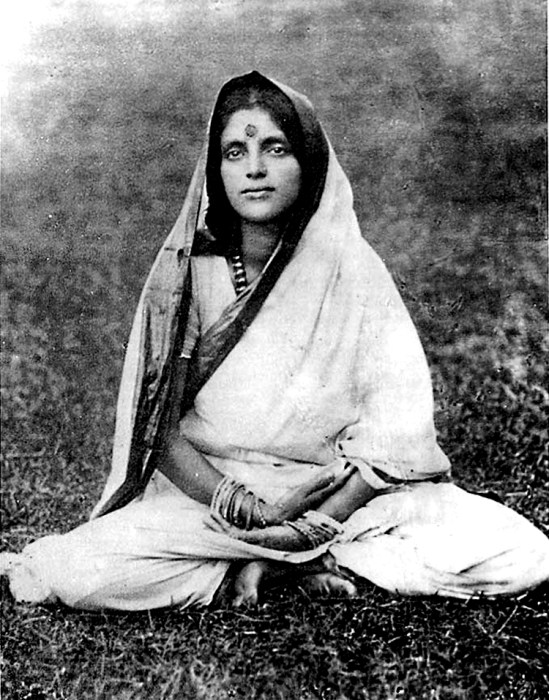
Ma Anandamayi – The Life of a Jivanmukta, or Living As The Self

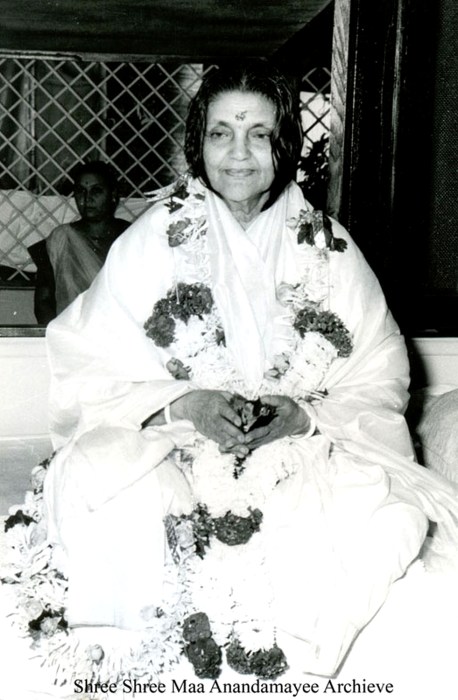
Shri Ma Anandamayi (1896-1982) was born as one who had already realized the Self in past lives, and who did not need to return to Earth for more perfection (jivanmukta). No one ever saw her with an instructor. By just living the day-to-day life of an ordinary householder, she showed others that it was possible to live as one united with God, while attending to the needs of her husband. For her, everyday life and religion or spiritual practice are ONE, there is no separation. This is the path to union with God, and we will see below through her life and teachings how this is possible. From time to time, great souls come back to Earth only for this purpose.

As Ma grew up, by herself she started on a spiritual practice (sadhana) which, people around her could see, brought her up a very high level, mainly through the repetition of God’s name, and spontaneous yoga postures or asanas. After repeating God’s name, “Sometimes she lay for many hours absolutely still and totally absorbed in an inner bliss. At such times her body emanated a radiance which was visible to onlookers.”

“Sri Ma lived the life of a pilgrim on the path of spiritual endeavour for nearly six years; during this time she initiated herself and proceeded thereafter in a more systematic manner. Bholanathji (her husband) realized that he was in the presence of a very special embodiment of Divine Power. He himself accepted the much-coveted initiation from Sri Ma within the first year of this manifestation. Thereafter their relationship acquired a new dimension – that of Guru and disciple, although Sri Ma never changed in her attitude of complete obedience and deference to Bholanathji’s wishes.

Referring to this period of her life, Sri Ma has said, “Sadhanas by which man endeavours to attain self-realization are of endless variety, and each variety has innumerable aspects. All these revealed themselves to me as a part of myself”. In later years she had occasion to talk about her experiences in select gatherings of ascetics, scholars or other seekers of Truth. The pandits have marvelled at her knowledge of all tenets of faith, in all their doctrinal details. Sri Ma has said that even so she has not talked about one thousandth part of all that was revealed to her during her years of intensive sadhana. Sometime in 1922 she became maunam – that is silent. This silence came as a mark of the fulfillment of sadhana. After the period of maunam (silence), she began to converse with visitors on religious topics.” (All these quotations are taken from Sri Ma Anandamayi’s website.)

Here are her teachings which are simple, clear and precise – very suitable for everyday life, with no need for erudition.


From Mother as Revealed to Me, by Bhaiji

Her instructions are of a universal type meant for all men, yet their real import is not always comprehended by people like us. Still, when some of her words illumine the mind of a particular person, what he realizes by his own limited knowledge finds expression in his life according to his own capacity to move forward. It is not easy to imagine how infinitely various are the streams of water flowing from the Himalayas to plains of India through glaciers, cataracts, rivers, streamlets and springs, enriching and fertilising many sterile tracts. Although the Himalayas do not lose anything by sending out these perpetual streams, the welfare of the world is being secured by them. It is similar in the case of Mother and her devotees.

The Divine Presence of Anandamayi Ma | Life Journey of Bliss Permeated Mother

The central theme of all her words and expressions is this: Life and religion are one. All that you do to maintain your life, your everyday work and play, all your attempts to earn a living, should be done with sincerity, love and devotion, with a firm conviction that true living means virtually perfecting one’s spiritual existence in tune with the universe. To bring about this synthesis, religious culture should be made as natural and easy as taking our food and drink when we are hungry and thirsty.

Just as a mother nourishes her child with all possible care and affection and makes him grow up into a healthy boy and a handsome youth, so you will find the subtle touches of the Divine Mother shaping your inner life and making you reach your full height and stature.

Mother says: “Just as there is a definite time-table for work at school, office or the shop, so should we set apart for divine contemplation a few minutes out of the twenty-four hours of every day, preferably in the morning and evening. One must make a fixed resolve that this little time shall be dedicated to God throughout life. During this period no worldly activity should be allowed to encroach upon the contemplation of God.

A fixed time for prayer or meditation must be allotted to all the members of the family including the servants. If this practice is continued for long, divine contemplation will become a part of your nature. Once the habit is established, the future course of your life will be made quite easy. You will feel the flow of the mysterious Divine Grace feeding all your thoughts and giving you new strength. You get a pension or bonus after years of hard work, so that you need no longer earn your livelihood. In the spiritual realm the reward for good, sincere and selfless work is even far greater and can be obtained more easily.

Those who amass money, store it up in a hidden chamber of their house, add to this store what they can save from time to time, and keep a constant watch over their treasure. So also reserve a little corner of your mind and heart for God and always steal an opportunity to add to your stock in the shape of the invocation of His name or some pious work or divine thought.

One day Mother was showing the various ways of saluting God and said: “Lose yourself altogether when bowing down to God with a single-minded devotion and you will obtain joy and power in proportion.

In this connection she added: “There are two kinds of pranamas : Offering to Him your whole body and mind with all thoughts, desires, sense-impressions, love, affection, devotion, just like emptying the contents of a full pitcher to its last drop. The other way is like scattering face-powder through the minute holes of a powder-box : the major portion of your thoughts and desires is kept back in a hidden chamber of your mind, and only a little dust is allowed to escape.”

Posted in Living Your Spirituality | Tagged | Leave a comment

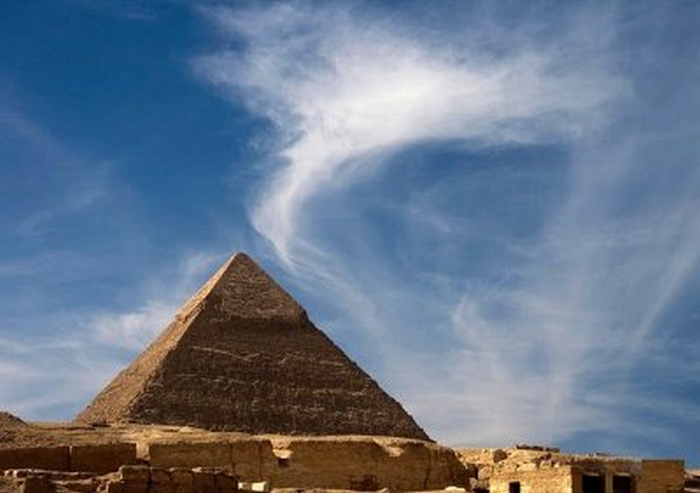
The Singing Stones of Giza – Jivanjili

Jivanjili recounts a fascinating event which left her group radiant after a visit of the Great Pyramid called Cheops. They were ready to be permeated by energy of the grounds without ‘knowing’ or ‘figuring out’ in advance, and they were rewarded.

There is a lot to study about the pyramids in Egypt, their sacred geometry for instance.
Every time I started to dive into that topic, I got lost in the complexity of drawings and theory yet fascinated in an intuitive way. I thought, if there is any powerful resonance in the sacred geometry of the pyramids, we must be able to feel, sense, experience at least some of it.

In January 2015 we went to Giza with a group and found some beautiful apartments with clear sight on the pyramids. Due to the negative publications about Egypt there are hardly any tourists currently, which adds to the serenity of the atmosphere. We went for ten days to roam around on the pyramid site, visit the pyramids and find probable powerful spots for meditation. We did not dive into any theoretical text, we were ready to be permeated by energy of the grounds without ‘knowing’ or ‘figuring out’ in advance.
As the days passed by, the group became more ‘transparent’, moving in slow motion.
The energy of ‘awe’ had set in so beautifully.

The invitation
One morning, a noble and friendly Egyptian man walked up to us.
He said: “If you want to stay for some time in the Kings Chamber with the sarcophagus in the Great Pyramid called Cheops, I advise you to go early in the morning before it opens and you will be the first one to enter. There are usually no visitors at that time and I will ask the guards to leave you alone for at least 10 minutes. You can go tomorrow”. We thanked him gracefully and said that we would do that. Mind you, 10 minutes seems to be a short time, yet not being harassed by guards (which usually happens) and be left alone, sounded very attractive. Apart from that, we felt to answer his kind offer.

Staying behind
The next morning we were all early ready to walk to the pyramid. Everyone carried a crystal. As we left the apartment building, I felt a strong pull from behind. I looked back en saw nobody there. Still the pulling did not stop as if I was pulled backwards by a magnet. Denying was not an option. “You stay and will be an anchoring point for the people”, is what I heard in my heart. I told the group that I was going to stay behind. Alone in the apartment, I sat in silence. In Noble Silence I ‘disappeared’, yet fully aware of infinite timeless presence… filling all of space, powerful resonant space. I never questioned this demand of staying ‘behind’.

The experience
‘The world’ came back through the sound of a turning key. The group had returned and entered so silently. They looked so radiant! I briefly looked at my watch…. nearly two hours had past. We sat in silence for a while and then they softly started to share their experiences one by one. As their experience had been so uniform, I like to write about it as in one voice:

“When we arrived, we had to buy tickets, as usual. Then the guards told us to enter the pyramid. Nobody followed. Walking the long stair-way, only hearing our own foot steps, felt already like an initiation. When we finally entered the Kings Chamber with the sarcophagus, there was indeed nobody there. We all sat against the wall for meditation and like within a second we fell in silence, in ‘overwhelming neutrality’, as one worded it. After a while we became aware of a deep resonant sound. Where was the sound coming from? We opened our eyes and saw a tall angelic looking man with very blond hair standing behind the sarcophagus. From where was he coming? We had not heard any foot steps on the stairs or other sound of someone entering. The man struck with his bare hand on the side of the sarcophagus. He was setting the sarcophagus in motion as a singing bowl!

Read the rest of the article here.

Posted in Living Your Spirituality | Leave a comment

Love Is Every Man’s Very Self

“Love turns man into an ocean of happiness, an image of peace, a temple of wisdom. Love is every man’s very Self, his true beauty, and the glory of his human existence.” ~ Swami Muktananda

Love is not just a sentiment, a feeling; it is a spiritual energy, Love-Wisdom from the second aspect ot the Divinity (who is known by different names such as Vishnu). God is Love and this energy is found throughout the creation, manifested in different forms – like that of cohesion.

In human consciousness this energy, Love comes to us from our Higher consciousness as Love-Wisdom and is reflected in the heart. That is why all highly realized beings manifest so much Love, and also know so many things that they could not have known by ordinary means. They are all known for their Love and Wisdom.

Shri Hans Raj Maharajji often said “Love is the Heart and Love is God. Everyone has a Heart, so everyone can realize God. Always live through your Heart.” Many great Masters also expressed similar ideas, like those below.

Posted in Living Your Spirituality | Leave a comment

Naropa Explores Listening to the Language Of Existence

In this interview in the hills of Trimurti, during the winter retreat 2020, Naropa explores the Parivartan: the shift in consciousness, being awake, going inward…

Posted in Living Your Spirituality | Leave a comment