In explaining “All is perfect” in her book In Our Hearts We Know, ShantiMayi shows us that the mantra Om Purnamadah is a powerful sadhana “… to apprehend the unspeakable, unknowable ‘Essence of Existence’ – the Universal Principle that weaves the dream-like quality into a viable experience.”
Here, we have given only the opening paragraphs, the introduction to the topic, but her explanation is contained in a whole chapter – which gives us the whole picture. Further on, after the paragraphs we quote, we learn, for example, that:
“This mantra is so profound. With clarity such as this, you go beyond the need to understand. This wisdom does not depend on the rational mind. It is realized through the core or your being. Its deeper implications are realized through spiritual wisdom and might take a lifetime to learn.”
🔷️ 🔷️🔷️
only the perfect remains
understanding and beyond
THE HIDDEN BEAUTY IN TRUTH IS... whatever is, is Truth. Whatever is not, is also Truth. There is no arrival, nor was there any departure. This is perfect as well as imperfect – both are true in essence.
Gosh!… Doesn’t that just turn your heart inside out ?
ALL IS PERFECT
How can I see the perfection in things that are all seemingly imperfect?
Understanding that “all is perfect” is not a small, personal, or dualistic view. It is a grand view attained through insight and realization. It is a cosmic view. We often feel that such an insight doesn’t apply to our daily lives, but it does. When your understanding encompasses the ways of the universe, useless fears, like the fear of death, disappear and drop away, and you are prepared for the challenges that life brings. The Upanishands (1) contain a mantra that is a very powerful sadhana – – a vehicle for reaching the incomprehensible (2) understanding. It is akin to Christ’s teaching about being in the world, but not of it…
_________________
(All the footnotes are from the text.)
1 The Vedas are the ancient scriptures of the Hindus and the Upanishads are the philosophical books of the Vedas. Very complex very deep… yet when our eyes have been opened by wisdom, the teachings are available. In my view you get from the Upanishads what you are capable of understanding. The teachings and topics are somewhat veiled in their language and require a spiritual maturity to create the resonance needed to extract their deeper meaning. The Upanishands are the root of non-dualism. Non-dualism awakens the student of wisdom to go beyond their rational mind into an intuitive tacit clarity so that the experience of Totality is possible.
2 Incomprhensible means unlocking the logical penned-in mentality to apprehend the unspeakable, unknowable “Essence of Existence” – the Universal Principle that weaves the dream-like quality into a viable experience. Intuition and resonance, silence, devotion, willingness, wisdom, yielding, strength, courage and openness are entrances beyond the superficial and into the incomprehensible.
___________________
Here is the mantra in the original Sanskrit…
Om Purnamadah Purnam idam Purnath
Purnam udachate Purnasya purnam udaya
Purnam evava sheshate
Om Shanti Shanti Shanti
Purna means “full, complete, total, and perfect”… This perfection is as things are. It is accurate, and it is so, and does not hinge on the approval or disapproval, acceptace or non-acceptance, of anyone whatsoever. Whether you ever understand or not, this is so. If you begin to analyse this, even slightly, you will not receive its deeper meaning.
The English translation (3) for this mantra is:
This is perfect
That is perfect
From the perfect
Springs the perfect
Take the perfect
From the perfect
And only the perfect remains
OM… peace, peace, peace
___________________
Footnote
3 This particular translation of the mantra is tantalizingly compelling because we have loads of ideas about perfection. Yet this mantra says all is perfect as it is. Here you cannot grapple with the notion of what you think perfection is; if you do, the real meaning slips away. With this mantra, you take a moment of silence and let it sink in. This particular translation is found in the Guru Gita from Swami Muktananda’s Siddha Foundation. Yet, I believe it to be a wildy used translation that may not have originated there. The mantra is found at the end of the Isha Upanishad.
__________________
Since everything is perfect as it is, then why do we feel the need to pray for things to be different than they are?
Understand that the prayer and the one praying are also included in this perfection. Purna means total and not exclusive. The people who live life with a prayer in their heart for the benefit of all beings are as perfect as the perceived imperfection they are praying about – it’s a perfect circle.
To access this wisdom is one of the deepest, most difficult, and yet most freeing insights available to you: to simply allow the universe to be exactly as it is. […] (Pages 79 – 82)
🔷️ 🔷️🔷️
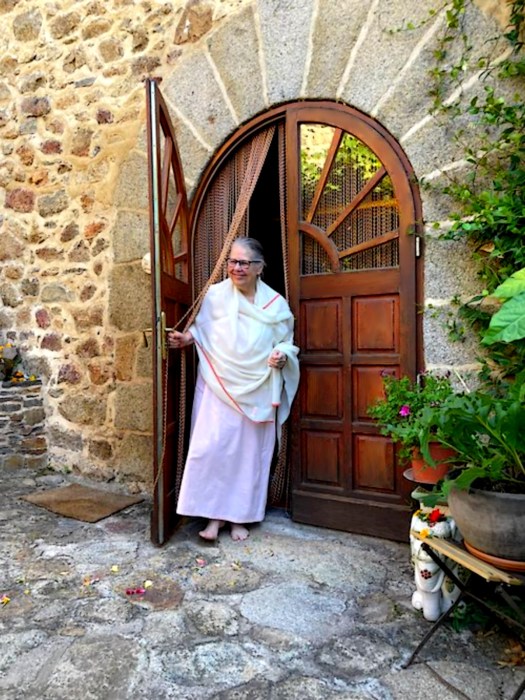
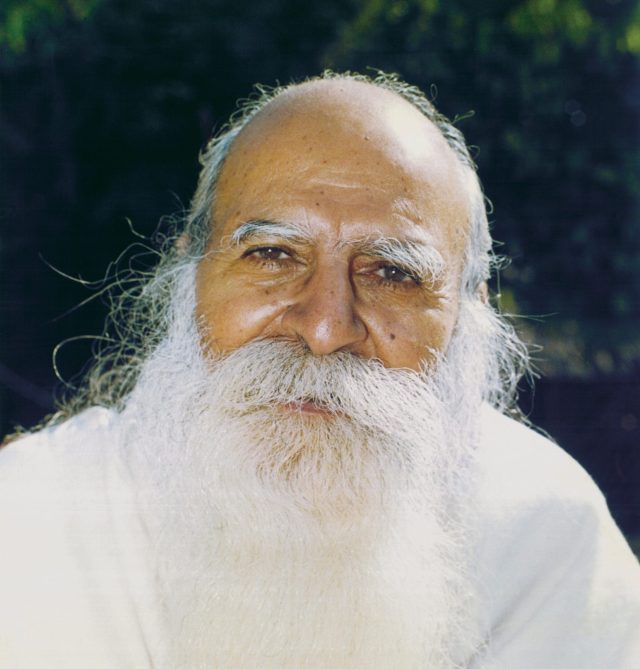
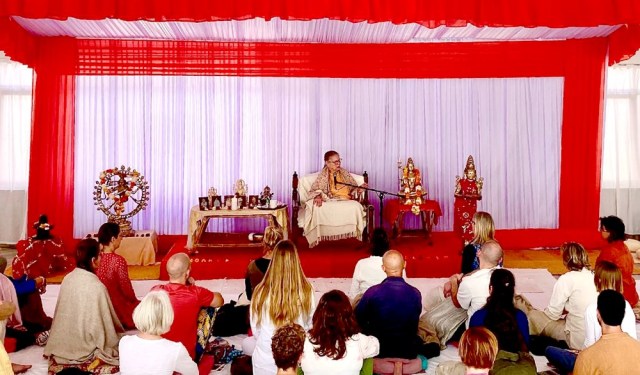
Shri ShantiMayi at her ashram Terre de Sacha in the French Pyrénées
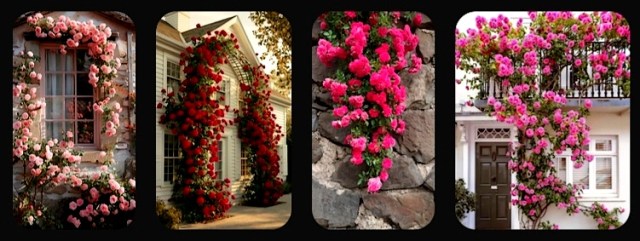
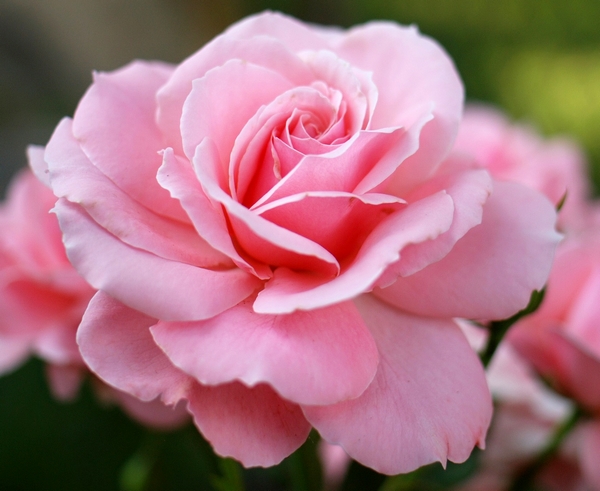
The rose has long been a revered symbol of divine love, transcending cultures and centuries. Its beauty and fragrance have captivated human hearts, making it a powerful emblem in various spiritual traditions. In ancient cultures, the rose was often associated with the Divine Mother, Whose energy is popularly called today, the Divine Feminine, representing Her nurturing and transformative qualities. This feminine energy is the essential counterpart to the masculine principle of pure consciousness (Shiva in Hinduism). Together, they represent the interdependent forces necessary for creation, sustenance, and transformation. This connection with the Divine Mother is deeply rooted in the symbolism of the rose as a vessel of divine love and wisdom.
It is closely associated,with the concept of sacred heart, which represents a convergence of spiritual, physiological, and symbolic principles that illuminate the path to enlightenment and holistic health. The sacred heart, therefore, is not merely a physical organ but a metaphysical center of compassion, intuition, and cosmic harmony. In Ayurveda, this aligns with the anahata chakra, the heart center that governs unconditional love and interconnectedness. Taoist medicine similarly associates the heart with the shen (spirit), emphasizing its role in balancing emotions and mediating between heaven (spirit) and earth (body).
The rose, as a symbol of the sacred heart, can be seen as an emblem of spiritual purity and regeneration. Its vibrational energy aligns with the sacred heart because it embodies the “maternal creative mystery,” a generative force that sustains life and consciousness. The lotus, its Eastern counterpart, similarly signifies the unfolding of divine wisdom, with its petals representing the chakras—vortices of spiritual energy along the spinal column. The rose and lotus reflect the sacred feminine principle (Divine Mother’s energy) of creation and the heart’s role as the seat of divine love.
In this article, we will briefly see the importance of the rose in some Eastern and Western traditions, as its symbolism sheds light on our spiritual journey, reminding us of the necessary path to take, guided by the feminine energy of the Divine Mother.
THE ROSE IN EASTERN TRADITIONS
In the vast tapestry of Eastern spiritual traditions, the rose emerges as a powerful symbol of divine love, enlightenment, and spiritual transformation. Its delicate petals and intoxicating fragrance have captivated seekers of truth for centuries, offering a path to inner peace and higher consciousness.
In Hinduism, the lotus is well known for symbolizing purity, spiritual enlightenment, and divine creation, with its roots in the mud but blossoming above water, while roses are more deeply associated with the heart, both symbolically and spiritually. They represent love, devotion, and the Divine Mother’s energy (through different goddesses), often linked to the heart’s capacity for pure emotion, and spiritual connection. Roses are often offered to Lakshmi, the goddess of both physical and spiritual prosperity, wealth and abundance – Vishnu’s Shakti.
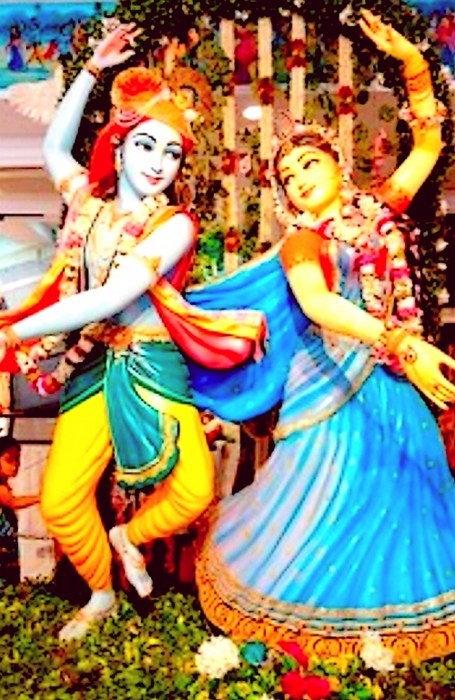
Beautiful Radha Kkrishna climbing roses
Roses hold deep symbolical significance in the divine love story of Radha and Krishna, representing pure, eternal, spiritual ties. In Hindu tradition, Krishna is often depicted showering Radha with rose petals, symbolizing the celestial dance of love between the divine Self and the personality. This poetic, profound image links the rose to the heart chakra—a center of love, compassion, and spiritual awakening. Each petal a testament to the continuous expansion of Radha’s heart…
In Hindu iconography, the roses which are frequently offered to deities signify the heart’s offering of love and gratitude. The unfolding petals mirror the soul’s journey toward divine love and enlightenment, while the fragrance symbolizes the essence of the heart’s purity and connection to the divine. This aligns with the broader spiritual belief that the heart chakra (Anahata) governs love, compassion and spiritual development—core values embodied by the rose.
The rose’s fragrance is believed to open the Anahata, promoting compassion and emotional healing. For this reason, rose petals and rosewater are commonly used in daily puja (worship) rituals and as offerings to various deities in temples.
The rose’s ability to bloom in various colours mirrors the diverse aspects of the Divine Mother, each hue symbolizing different qualities and blessings.
Within the Indian Sufi tradition (an esoteric branch of Islam), the rose, or Gul, became a metaphor for the lower self’s journey toward the divine. The beauty and eventual wilting of the rose mirror the ephemeral nature of earthly existence and the search for eternal truth. Sufi poets frequently used the rose and the nightingale to represent the beloved (God) and the ardent lover (the seeker).
In Sufism in general, the rose holds a special place as a symbol of divine love and mystical experience. Sufi poets, such as Rumi, often used the rose as a metaphor for the personality’s journey towards union with the divine. The rose, with its delicate petals and thorns, represents the duality of human existence — the struggle between the material and the spiritual. In Sufi mysticism, the rose is seen as a symbol of the heart, which must be purified and opened to receive divine love.
The practice of offering roses in Hindu rituals and ceremonies underscores their spiritual significance. Whether placed at the feet of a deity or used in puja ceremonies, roses are believed to carry prayers and aspirations to the divine realm. This act of devotion is not merely symbolic; it is a tangible expression of one’s commitment to spiritual growth and enlightenment. As devotees engage in these practices, they are reminded of the transient nature of life, just as the rose’s petals eventually fall, encouraging them to live with purpose and mindfulness.
In Buddhism, the rose is often interpreted as a symbol of the path to enlightenment. The lotus, while more commonly associated with Buddhism, shares similarities with the rose in its representation of purity and spiritual awakening. Both flowers bloom amidst the mud and water, symbolizing the ability to rise above worldly attachments and achieve enlightenment. The rose, with its thorns, also represents the challenges and obstacles one must overcome on the path to spiritual growth. Each thorn is a reminder of the lessons learned and the strength gained along the way.
♦ ♦ ♦ ♦ ♦ ♦ ♦
THE ROSE IN WESTERN TRADITIONS
In Christian mysticism, the rose is often a symbol of the lower self’s journey towards union with the divine. The rose, with its thorns and petals, serves as a metaphor for the challenges and rewards of the spiritual path. Just as the rose blooms despite its thorns, the personality can achieve enlightenment by overcoming obstacles and embracing the transformative power of love. This allegory encourages believers to persevere in their spiritual quest, knowing that divine love awaits those who remain steadfast in their faith.
The mystical teachings of Christianity often draw parallels between the rose and the heart, seeing the flower as a reflection of the human heart’s capacity for love and compassion. In this context, the rose’s fragrance is said to represent the sweetness of divine grace, while its beauty symbolizes the inner radiance that comes from a life dedicated to spiritual growth.
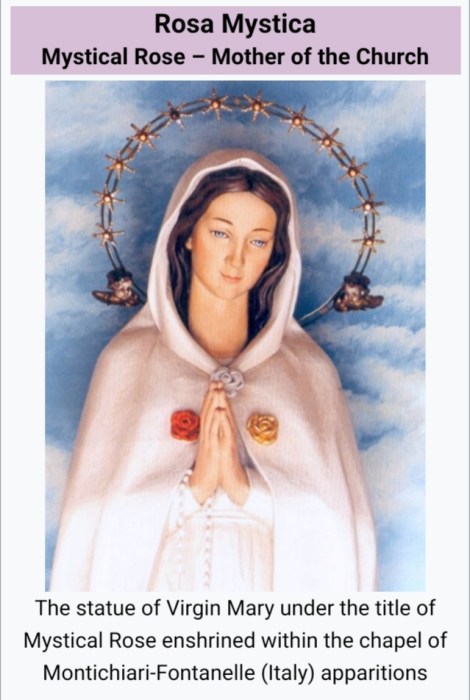
In Christian mysticism today, among the different representations of the Virgin Mary, we find three roses associated with one of Her forms. This Virgin Mary statue represents Mary wearing a white dress and three roses on her heart – white, red, and golden – symbolizing prayer and purity, sacrifice, and penitence, respectively. This devotion is rooted in Marian apparitions reported by Pierina Gilli in Montichiari and Fontanelle, Italy, between 1947 and 1966. The twelve traditional stars represent Her status as Queen of the Universe and Mother of the Church. (Wikipedia)
Alchemy and the Rose: The Flower as a Metaphor for Spiritual Transmutation
In the realm of alchemy, a mystical and transformative practice that sought to turn base metals into gold, the rose emerged as a profound metaphor for spiritual transmutation. Alchemists, those seekers of truth and enlightenment, saw the rose not merely as a flower but as a symbol of the lower self’s journey towards perfection and divine union. This journey, much like the alchemical process, is one of purification, transformation, and ultimately, rebirth.
The rose, with its delicate petals and thorny stem, encapsulates the duality of this path – beauty and pain, light and shadow, the divine and the human. It became a central symbol in the alchemical quest, representing the highest ideals of spiritual growth and the ultimate union with the divine.
The rose, in its full bloom, reflects the alchemist’s goal: the achievement of the Philosopher’s Stone, a symbol of enlightenment and transcendence. This metaphorical journey mirrors our own path towards self-discovery and spiritual awakening, where we too must navigate the thorns of life’s challenges to reach the blooming rose of our true Selves.
In the alchemical symbolism of the rose, we find that it is a gateway to understanding the mysteries of the universe and our place within it. The rose’s association with the Divine Mother further enriches its symbolic significance, representing love, compassion, and the nurturing aspects of the cosmos. In the alchemical tradition, the rose garden is a sacred space where the personality undergoes its transformative journey, guided by the wisdom of the Divine. This process of spiritual alchemy is not merely an abstract concept but a lived experience, one that invites us to engage with the mysteries of life and to seek the gold within our own beings.
The Rose in Medieval Symbolism: Knights, Saints, and Sacred Geometry
In medieval times, the rose transcended its botanical identity to become a sacred symbol woven into the fabric of religious, mystical, and chivalric traditions. In medieval Christian tradition, the rose was often associated with the Virgin Mary, embodying purity, grace, and the pervasive qualities of the Divine Mother, of Whom Mary was an aspect. The rose’s association with Mary can be traced back to the early church, where the flower was seen as a symbol of her immaculate conception and perpetual virginity – qualities of the Divine Mother. TheMystical Rose title, bestowed upon Mary, underscores her role as a bridge between the earthly and the divine, reflecting the rose’s ability to connect the physical and spiritual realms. This symbolism is particularly evident in the works of medieval mystics, who saw Mary as a mediator of divine grace and a source of spiritual inspiration. The rose, in this context, represents the path to spiritual enlightenment and the transformative power of divine love.
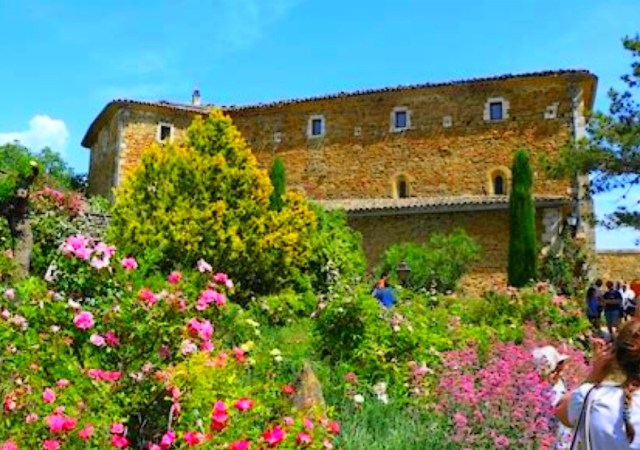
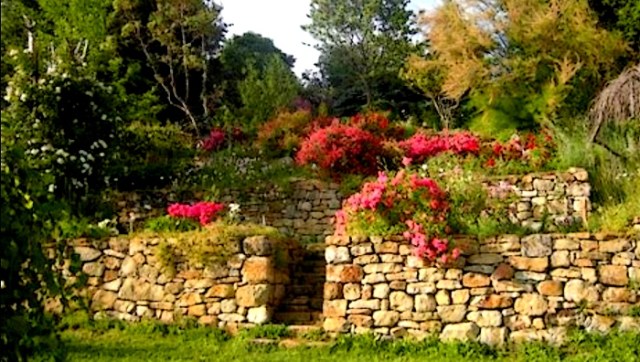
Valsaintes Abbey and Roseraie (rose garden) in France, originally a Cistercian Abbey, founded around 1180, and restored from 1996. The garden is now renowned for its wild, bushy rose collection, featuring over 600 varieties of roses, including ancient, wild, and modern cultivars. Species such as Rosa gallica, Rosa canina, and Rosa pimpinellifolia grow naturally alongside rambling and shrub roses, blending harmoniously with wild flowers, lavender, and native plants.
The knightly orders of the Middle Ages also embraced the rose as a symbol of chivalry and spiritual quest. The Knights Templar, warrior-monks, for instance, incorporated the rose into their iconography, viewing it as a symbol of Virgin Mary, the Divine Mother and a reminder of the spiritual journey each knight undertook. The rose was seen as a guide on the path to spiritual enlightenment, embodying the virtues of courage, purity, and devotion. This association is evident in the stories of chivalric romance, where the rose often appears as a symbol of the knight’s quest for a higher truth or the attainment of spiritual grace.
Monastic and royal rose gardens were not merely ornamental but served as sacred spaces for contemplation (meditation) and spiritual renewal, as they harnessed the flowers’ aromatic and meditative effects. They used the capacity of the roses’s perfume to open the heart centre, facilitating emotional release and spiritual alignment.
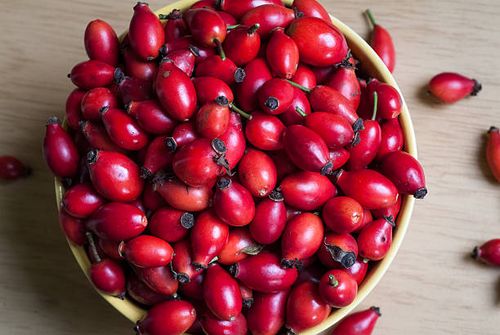
Rosehips
The rose (Rosa gallica “Officinalis”), extensively used by the Templars was highly valued, not only for its beauty and fragrance, but also for its medicinal and practical uses, including making rose water, rose oil, rose honey, and potpouri. Rosehip jelly was a special favorite during the winter.
♦ ♦ ♦
The rose’s association with saints and mystical figures further enhances its spiritual significance. Saint Rose of Lima, for example, is revered for her devotion and asceticism, embodying the virtues represented by the rose. Her life story, filled with acts of charity and spiritual discipline, serves as an inspiration for those seeking spiritual growth and divine connection. Similarly, the mystical experiences of figures like Hildegard of Bingen, who saw the rose as a symbol of divine wisdom, highlight the flower’s role in spiritual revelation and guidance.
♦ ♦ ♦
Sacred geometry – the study of geometric patterns and their spiritual significance, also finds expression in the rose.
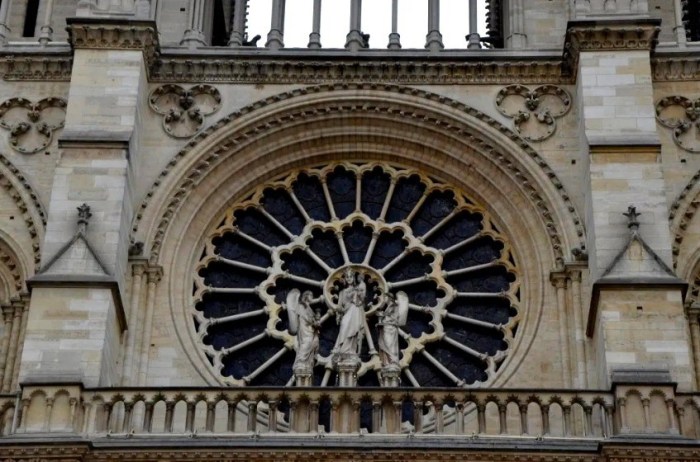
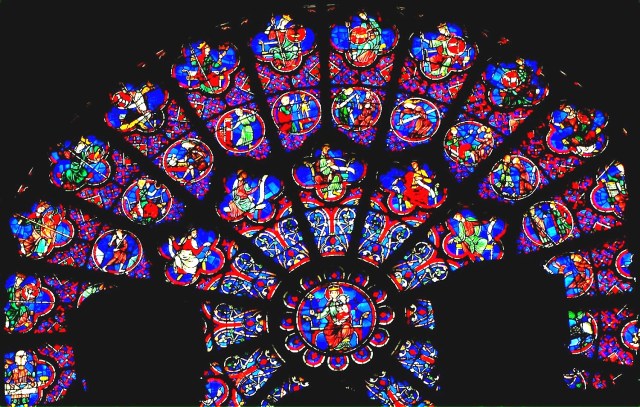
The rose window, a common feature in Gothic cathedrals, is a testament to the integration of sacred geometry and rose symbolism. These windows, with their intricate patterns of circles and spirals, transmit the belief that the universe is structured according to divine proportion and harmony, reflecting the “Divine Mind”. The rose’s spiraling petal arangement mirrors the Fibonacci sequence, a pattern seen in galaxies and sacred geometry. This “golden spiral” symbolizes the heart’s connection to cosmic energy.
The radiating petals of the rose window also symbolizes the expansion of consciousness and the revelation of divine truth. It serves as a visual representation of the spiritual journey, where each petal or section of the window represents a stage in the path to enlightenment. The rose window, with its detailed visual teachings, was also meant to be a Bible for the illiterate.
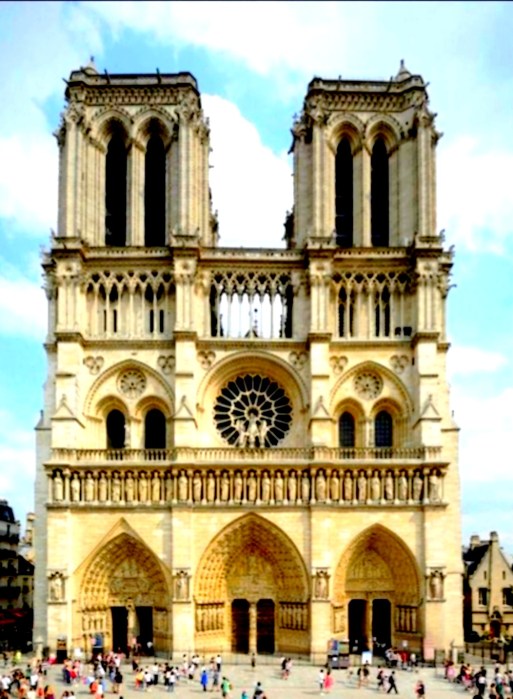
We will now see an example of this with the west rose window (rosace ouest) of Notre Dame de Paris Cathedral (Our Lady of Paris Cahedral). The images of this window have been taken from the article (in French) Cathédrale Notre Dame de Paris, rosace ouest, vitraux des vices et des vertus.
Notre Dame de Paris cathedral main entrance, with the west rose windowOutside vue of Notre Dame west rose window. At the centre of the rose is the Virgin Mary, Mystical Rose, holding the Christ Child.West rose window of the Notre Dame de Paris cathedral, upper half, window of Virtues and Vices. Parts of the organ hide some of its lower parts.
The lower half of the rose window features the Twelve Signs of the Zodiac and the Labours of the Months, illustrating the medieval calendar and cosmic order.
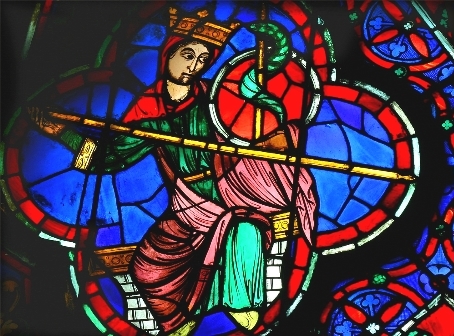
The upper half displays a psychomachia, an allegorical battle between Twelve Virtues and Twelve Vices, presented in opposing pairs. The virtues—like Charity, Patience, and Chastity—are depicted as serene, crowned women holding shields (developed hearts) and rods. The rod is a common attribute symbolizing authority, righteousness, and the power to overcome the Vices. This imagery aligns with the window’s theme of the psychomachia, the allegorical battle between Virtues and Vices. They are crowned because they are queens, representing the wisdom of the higher world, the higher Self, which is our model, but especially because they show the behaviour of an enlightened person, a saint (hence the crown), of those who have lived through their hearts (the rose-shield, the sacred heart) in all their doings, and have thus gained their place in the realms of the divine.
While still on Earth with other people, they are models of the wisdom and guiding energy of the Divine Mother – symbolized by the snake, (popularly known today as the Divine Feminine, the fundamental cosmic energy and power that underlies and animates all existence). In Hinduism it is known as shakti, among other terms. In contrast, the vices—such as Avarice, Pride, and Anger—are shown through dynamic scenes of human folly through lack of wisdom, illustrating their destructive consequences when one follows the lower mind, not the heart. This duality emphasizes the medieval theological belief that salvation required working constantly through the heart, with the mind fixed on the Divine, so as to be guided safely home. In that way, one obtained the grace of the Divine Mother.
The Pairs of Medallions
From left to right, we find the pairs of medallions. Virtue is in the outermost circle in the four-petaled flower, and vice in the circular medallion to its right.
The terms vice and virtue contain the ladder to be climbed, a set of visual aphorisms which allow the seeker to master his human nature (lower self, personality), and not get lost in unsuitable behaviour. Eastern philosophers also use such terms to express their ideas, like the Aphoroisms of Patanjali, the main codifier of classical yoga in Hinduism.
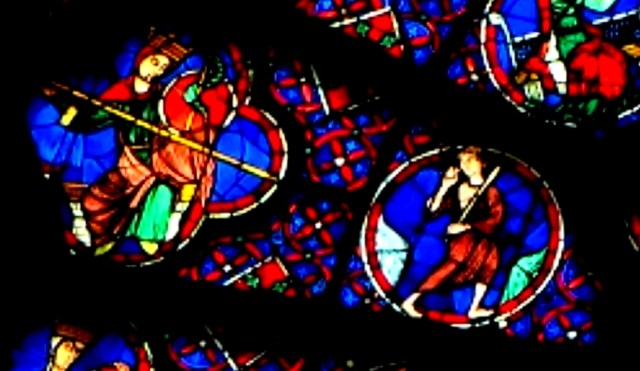
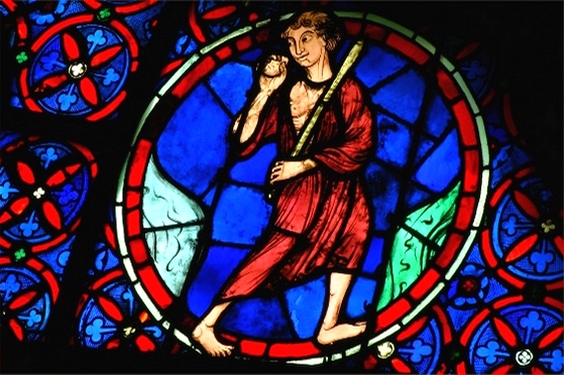
Detail of west rose window – medallion of Wisdom (left) and Folly (right)
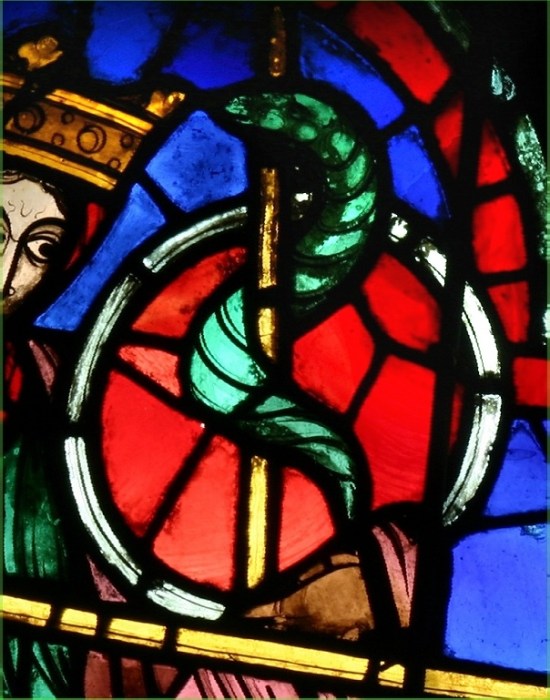
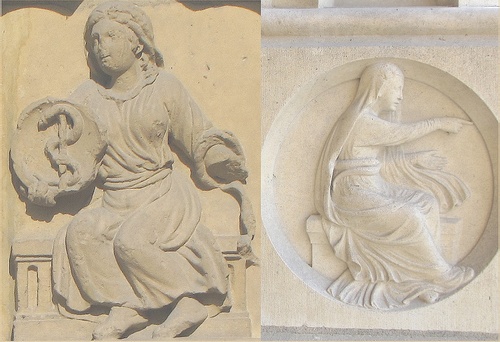
Detail of the medallion: Wisdom, symbolized by the tamed serpent wrapped around a vertical rod, and a crowned woman, the crown symbolizing illumination, union with God.
In the centre of Wisdom’s shield, symbolizing the sacred heart, and which has the appearance of a big rose, is a serpent wrapped around a rod. It is akin to the Caduceus, but here, there is only one serpent and no wings. This was probably simplified for those who did not know its symbolism, and so the Rod of Asclepius was used instead, the true and ancient symbol of medicine, which would have been familiar to people of that time. The Caduceus symbol originates in the staff carried by Hermes, the messenger of the gods in Greek spirituality (known as Mercury to the Romans, and Thoth or Thot, in ancient Egypt). It is typically depicted as a short staff entwined by two serpents and surmounted by wings, symbolizing enlightenment. Its message here, set out with just one serpent and no wings was understood on a higher level by spiritual seekers and initiates.
On the left, Virtue and the serpent wrapped around a staff (XIII C workshop), on the right, Dialectic, where the belt is a serpent (XIX C workshop).
The meaning of the serpent is made clear on the west side of the central trumeau of the porch, where we see a serpent (the feminine cosmic energy) wrapped around the waist of a woman personnifying Dialectic, one of the “Voces” of the medieval Trivium – a voice of reason. This term indicates that the wisdom to be acquired here, is akin to the Word, the wisdom and creative power acquired through spiritual development, leading to the mastery of the dialectic method of reasoning, questioning and synthetising truths intuitively. This wisdom also confers keen spiritual insight, as we see by the way the Saint looks at the object she is aiming at, she sees it through the rose-shield. Indeed, she sees things through her heart (the rose, the shield), and so is able to focus perfectly on what she is doing, take aim at (here, the vice Folly), and hit the target or accomplish her task perfectly.
That the serpent is wrapped around the waist means that this wisdom has been acquired through personal effort, through Godliness, living through the heart, and so has been personalised. It enables the spiritual seeker to speak and act with wisdom, symbolized by the serpent – the feminine energy which rises up through the spiritualizing centres of the spine to the supreme states of divine realizaton. Indeed, we notice in our medallion that this feminine energy is anchored in the heart, the rose, which is not only a source of wisdom, but also a shield, a protective energy in many ways, and from there has risen to the crown of the head.
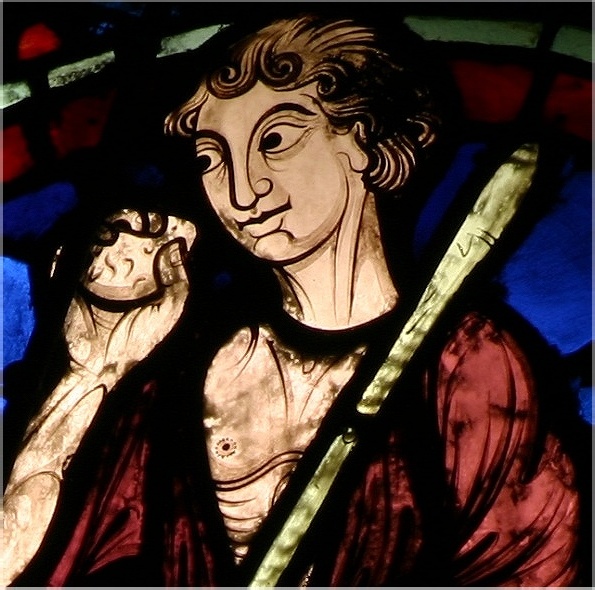
Keen sight, wisdom, are the opposite of the simple-minded attitude of the man in the complementary medallion, Folly, where he strides along while looking backwards. His equilibrium is based upon a vision of the past, he does not see the future, to which he turns his back. Barefoot, unkempt, with naked chest, (i.e. he is devoid of spiritual qualities) he holds in his right hand a oval-shaped object next to his ear, symbolizing the fact that he only follows his lower mind, not his heart.
His left hand holds a short stick with an enlarged top. This stick is the opposite of Wisdom’s rod representing the wisdom-giving spiritual tree – the spinal column, for with its enlarged top, it is the stick held by a buffoon, commonly known as a marotte – a scepter-like prop, often topped with a small carved, grotesque head. He is quite simply a ludricous or bumbling person, a fool.
What is clear is that Folly does not use what nature has given him to get along in the world. He is not conscious of the spiritual world, and makes no use of the staff he is holding. He attaches no particular importance to his heart, and therefore has no wisdom nor anything to help him, nothing for him to lean on. His ears and mind are tuned only to earthly sounds, which do not help him. So Folly has no guiding principle in his life. He has not yet mastered life in the physical world, in day to day life, and is therefore like a helpless child and is tossed around, at the mercy of whatever comes along.
Let us remember that one of the reasons for building these cathedrals, was to use visual art to teach spiritual truths. And here we see that in the medallion of Wisdom and Folly our attention is drawn to the importance of living through the heart, symbolized by the rose-shield, working through it in order to allow the spiritual energies of the body to do their transformative work and lead to mental and spiritual growth, and the acquisition of wisdom.
Thanks to this wisdom, coming from the higher consciousness, one is able to see the goal, the purpose of one’s life – which is to achieve union with the Self, with God – and work accordingly. Otherwise, one is like the simple minded person whose life is empty, and who finds it normal to drift along aimlessly, constantly reincarnating without understanding what life is about, and the reason for so much suffering.
To help us benefit from these teachings, the rose plays a key rôle in transmitting its spiritual truths. These images, medallions, are symbols which speak to the subconscious mind, and teach spiritual truths which will bear fruit sooner or later as we remember them, and think about them. What is at work here, is not the brain, but the heart, the Sacred Heart, symbolized by the rose.
♦ ♦ ♦ ♦ ♦ ♦ ♦
The rose’s journey through time is a testament to its enduring significance as a symbol of divine love, spiritual transformation, and enlightenment. As we get a glimpse the rose’s rich history and multifaceted symbolism, we are invited to embark upon a sacred journey of our own, one that leads us ever closer to the heart of our being and the divine mystery that lies at the core of all existence. The rose is a beacon that calls us to prepare for the journey ahead, creating an ‘etheric double’ that reflects our highest aspirations and deepest longings. As we heed this call and embrace the rose’s guidance, we open ourselves to the possibility of profound transformation and the awakening of our true nature.
Towards the end of the year, there have been Festivals of light, which invoke God’s Light and Blessings. This contributes to strengthening the spiritual energies for the New Year – giving it a good push on a positive path.
The Sacha lineage is particularly dedicated to bringing more light into the world, and have created mantras which assist this process. One of these mantras is the Prabhu Aapa Jago, created by Saint Sacha Baba Kulanandji – Avatar of Vishnu and Narada.
The purpose of Sacha Baba Kulanandji’s powerful mantra is to to make it easier for everyone to attain a higher state of consciousness and then spiritual enlightenment — not only to alleviate pain and suffering, but especially to make humanity ready for the new era coming in.
Although the Prabhu Aapa Jago mantra is sung daily in Sacha ashrams, and for personal sadhanas, there are Sacha disciples all around the world who chant it specially from 12:00 on 31st December to 12:00 on 1st January every year, to create a favourable atmosphere for peace, happiness and Light .
The chanting of many people at the same time creates a powerful invocation of Divine forces who then give assistance in the transformation of hearts and consciousness. The Light we are looking for is to be found within ourselves. The Divine forces, in particular the Divine Mother – source of all Light, help us to bring forth that Light.
The mantra is a call to the Divinity to help us to progressively attain enlightenment in this very life, and experience true happiness — Bliss. (End the play of suffering. Bring light to the play of bliss.)
“Prabhu Aapa jago, Paramaatma jago, Mere Sarava jago, Saravatra jago Dukhaanta ka Khela Kaa Anta Karo, Sukhanta ka Khela Prakaash Karo”
( Lord awake, awake Supreme Self, Awake in me, awake in everyone. End the play of suffering Bring light to the play of bliss.)
One can chant the mantra aloud or inwardly, at any time. Some prefer to chant in groups (the energy is stronger), while others prefer to do so individually. Naturally, one can continue this invocation of Light during the new year, throughout the year.
What external condition is essential for enhancing the quality of work? Light. Only light makes work productive and useful. A butterfly can fly as long as its rainbow pollen does not run out. Human beings possess the very same rainbow force, which takes in the power of light by means of photoplasm. The various plasms are intermediaries between the visible and the invisible. Being an emanation of the nervous system, photoplasm forms a rainbow pollen that receives rays of light and conducts them into the nerve channels.
Since the best links with light are obtained in the morning, do not shut out the morning light. Work in the light, make decisions in the light, make judgments in the light, grieve in the light, rejoice in the light. Nothing compares with the light wave. Even the very best electricity, even the bluest, yields eight thousand times less light than a ray of the sun.
Soon the study of photoplasm will impart a new direction to methods of work. One can see how the pollen of photoplasm surges forth and conveys through tiny funnels the treasure received, carrying it into the pores of the skin.
Not only the spaciousness of work areas but also proper access to light needs to be studied. The sun’s rays should be appreciated as a universal treasure.
A scientist who studies the topics above will also easily come to understand the flow of rays from other luminaries.
Why should people pass by the treasures of the universe that have been destined for them?
The rhythm of the planets is made up of magnetic vortices and light. Can they not be put to use, just as the power of waterfalls is? Inexhaustible are the forces made available!
New Joes and new Janes, you who number in the hundreds of thousands, take your share! Soon, what was a mere attempt will become a conquest, and the seed of the Common Good will give every person the power of the ray.
Let us remember this when we begin our morning work and courageously continue it into Infinity.(AUM)
The celebration of Prakash Diwash or Sacha Baba Maharajji’s enlightenment on 3rd October is a time when we reflect on the help and guidance given to humanity by Masters who gained immortality long ago, in past lives, and who come back to our world to help us through difficult periods. We think in particular, with deep gratitude, of Sacha Baba Maharajji, Sacha Baba’s Avatar. Although we can receive his blessings at any time, on this day, we connect with him to receive his special blessings.
Through Maharajji, Sacha Baba, the great being, a Kumara (Mind-born Son of Brahma, Archangel, Sephiroth), helped humanity both individually and collectively, as one body. Below, there is a short indication of what their work entailed.
Help for Individual Disciples
Maharajji, as the latest incarnation of Sacha Baba, after Sacha Baba Kulanandji, dedicated his life to the spiritual uplift of the world. In 1996 he said about an aspect of his work,
“I also do a sadhana – not for myself, but for the universe, for you people. So I sit inside, go outside for a short time. I pray to God so that he can give materially and spiritually to everybody.
In this world when men die, they leave with so much evil. But the way it should be, is that when one leaves the body, one attains this state of jivan mukta (union with God and no rebirth necessary).
(Speaking to ShantiMayi’s disciples in 1996) So all of you, with ShantiMayi [if you sincerely follow the sadhana given by ShantiMayi, with a perfect heart to heart connection], you will attain jivan mukta. This is a sankalpa [decree] of Sacha Baba.” (DVD 5 Gurus High – The Sacha Lineage of Gurus, Jan 1996)
This is so with all duly designated Masters of the Sacha lineage:
“Sacha Baba received a special mantra by which we can attain Self-Realization. This mantra Sacha Baba gives to his authorized disciples privately, and Masters of the Sacha lineage can pass it on to their disciples. This practice is still continued.” (Shri Hans Raj Maharajji — Sacha Baba and Japa)
To sum up, we could say that Sacha Baba Kulanandji has considerably reduced the distance between man and God, not only through his teachings, but also by special work carried out on the higher planes of consciousness, so that disciples of the Sacha lineage can attain realization more quickly. The fact that he was the incarnation of such a great Being as a Kumara, had certainly allowed him to carry out such action.
Help For Humanity as a Collective Disciple
[To help the world reach a higher state of consciousness and more easily go through the great changes of the Parivartan cycle that are now taking place], “…my Guru Sacha Baba prayed his whole life that this world should change slowly, little by little – not all at once. He was told by his inner voice:
‘If you want to change the world in one day, it is possible, but there will be a time of war, and only 20 – 25 per cent of people will remain in the world.’
But my Guru Sacha Baba did not want that, so he prayed his whole life that more and more men would be saved and become realized, or that maybe they would be given more time. So I also do this same prayer to change the universe, not through destruction, but through perfection. That is the aim of my life, like that of my Guru. (5 Gurus High, 1996)
In 1991 according to Maharajji, who had already become Sacha Baba (in 1983), his meditation for humanity especially concerned the mutual comprehension between the East and the West. Indeed, his scope of action covered the whole world, and as humanity is one body on the inner planes, sharing the same Universal Soul (each person also has an individual soul), it was/is of primordial importance for him to work for the healing of the different parts of this body. This is necessary to ensure the smoothest transition of the planet into the growing light of the upward swing into the new era.
These two Avatars of Sacha Baba, like Kacha Baba and Sacha Baba Girnari before them, knew that the downward phase of the Yuga cycle was ending with the end of the first part of Kali Yuga, and that we were now in the ascending phase of the next 12,000 years. We are actually in the ascending phase of the Kali Yuga – a period of transition known in the West as the Age of Aquarius, where the new energies with higher frequencies are rapidly replacing the old ones. So what exactly is the problem? Why did the Masters start preparing humanity for these changes over a century ago, with Kacha Baba?
Going Towards a Rise in Consciousness
They did so because they knew that the new energies would bring great disaster if men did not become more spiritual, and they wanted to help them change, to spare them those trials. The problem is that these energies come to build a new consciousness, a new way of thinking and living, whereas far too many people do not go in that direction. They remain selfish and see themselves as completely separate from other human beings, and we can see today what disasters this attitude brings. In short, the lower self remains the master, while the new energies work against that.
It is this friction which creates the disasters. After the development of the physical body, followed by increased mental capacities, it is now time for the soul (individual soul) to express itself more and more clearly. It is time for man to be more guided by the wisdom of his soul, which is divine, being firmly anchored in God, instead of blindly following his instincts and lower mind. They were necessary in the past, but today man is going towards adulthood where the ruler of his consciousness will be his soul. This will bring more love and sharing.
Let us remember that man is Spirit living in a lower self, and that his purpose on this Earth is to gain enough wisdom to finally mould the lower aspects of his being into a suitable vehicle for the Spirit, God in man. This entails uniting the lower elements of his consciousness with the higher ones.
Man now has to live more through his heart, and at the same time, his mental capacities increase. This brings about harmonization with the Aquarian energies. However, those who do not adapt to these energies, because they continue to live in a selfish, materialistic way, will have great problems in their lives. While Aquarius brings great possibilities for mental and spiritual development, it is also known for its conflicts and disasters, where many, many lives are lost.
In any case, we cannot enter the next Yuga – Dwapara Yuga without radical changes in our consciousness. Its frequency is far too high for many of the people of today, and that is why this period of transition from darkness to much more Light is necessary; it will give people more time to adapt. Those who, instead of following their good tendencies, their heart, and God, persist in the old ways of Kali Yuga, will be able to see very quickly their mistakes, and change if they wish, or… keep their low vibrations, along with their Kali Yuga status…
Sacha Baba has said that there will come a time when there will be nobody living who does not believe in God. He has often said that those who keep their mind fixed on the divine by, for example chanting the name of God, or a regular sadhana, etc. will easily come through this period. We are in a spiritual initiation, the whole planet is in this initiation, and the frequency of the Earth is changing, as the energies push us up to a higher place in the spiral. We can all pray for the smooth harmonization of humanity with these new frequencies so that more and more people live through their hearts.
It is with deep gratitude that we celebrate Sacha Baba Maharajji’s enlightenment, which enabled him to do particular work with Sacha Baba for disciples and all humanity. Although he gives special blessings today, we can connect with him all year for guidance and peace of mind.
Sacha Baba Maharajji’s annual Enlightenment Day celebrations will take place at Sacha Dham ashram on 3rd October 2025. It is an occasion where Sacha Baba showers particular blessings upon all God’s children on this planet. Sacha disciples connect with him because they know about him, but his care and blessings are showered upon all. Maharajji left his body in 2011, but he continues to inspire disciples of good will.
In this message, he touches upon different topics, while insisting on the necessity to maintain a steady sadhana for one’s spiritual progress and well-being. He also tells us that one way of helping humanity in its present struggle to reach a higher state of consciousness is for the devotee to become realized and then help God in his work, from whatever country he chooses. Helping disciples to succeed in this endeavour is a very important aspect of an Avatar’s work.
Om Akhanda Manadala Karam Vyaptam Yena Charaacharam Tadpadam Darshitam Yena Tasmai Sri Guruve Namaha (The Guru can guide us to the supreme knowledge of THAT which pervades all moving and non-moving beings in the entire Universe (namely Brahman). I salute such a Guru.)
My Souls, Today we celebrate Prakash Diwash – the day I became enlightened. That Light is in everyone, by which everyone moves and acts. In some way, by the Guru’s grace it is revealed.
The Avatar, the Guru
You think I’m sitting in this chair – but it is He who is within who sits. Name and form (1) cannot sit. He eats. He expels the name and form and sits within. They call Him “Avatar”. After Guru Nanak there were ten more. Guru Nanak said,
“Guru and Govinda [one of the names of Krishna – eighth Avatar of Vishnu] were both standing. Whose feet should I worship?”
Out of his grace the Guru told me to worship Govinda. Nanak was merged in Govinda. This can be understood in two ways. Nanak got merged into Govinda like water into water. As water is to be found inside water, likewise Guru dwells inside the Guru. The Guru sits right there. If someone else sat there, that would become “ego”. He throws it out, and rules supreme.
________________
(1) Name and form represent the dual aspects of identity and existence, where names serve as mental labels and forms as physical manifestations. In Hinduism, they signify the illusory aspects of reality, creating an illusion of separateness among souls. They represent superficial identities that bind individuals, obscuring the deeper essence of Spirit and the ultimate unity with Brahman (the Self).
Words of Wisdom
There is a verse in the Gita, (2)
“Nirmana Moha” – they have no delusion. “Jita sanga dosha” – they have no evil attachment. “Adhyatma nityam” – he that has constant love for Paramatman “vinivritta kama” – desire is absent. “dvandvair vimuktaḥ sukha-duḥkha-sanjnair” – free from dualites like joy and sorrow etc “gachchhanty amuḍhaḥ padam avyayam tat” – In that manner, the wise attain to Parmatman.
This is only one verse from the Gita, that on the field of Kuruksetra, Bhagavan Krishna spoke to Arjuna. You should remember that verse. If you do anything wrong, by clinging to it, it won’t make it right.
Maharajji (his Master Sacha Baba Kulanandji) also spoke powerful words, on different occasions. He went to Nemisaran, and also to his birthplace. That the body went means nothing. The Mahapurusha spoke his order for the three generations to come. He gave his orders [to the spiritual world].
Bhagvad Gita 15.5: Without craving for honour, free from delusion and malignant attachment, all longings banished, disengaged from the pairs of opposites — pleasure and pain — ever established in the Self, the undeceived attain the immutable state (the Self).
The Need For True Knowledge
There was a devotee who wanted Sacha Baba Kulanandji to help him realize his political ambitions. He did not get to see the Master because he was absent, and he was told that he had already had his blessings, but had not realized them. Later on, he rose to a high position in the government and decided to seek vengeance by putting the Master in jail. A man went to warn him privately about the plot. The Master made him speak loudly for everyone to hear, and then exclaimed, “Behold! The chief minister has fallen (from the government)!” He had fallen. That was all. He is the Master of the three worlds (a Kumara, Mind-born Son of Brahma, Archangel, Sephiroth); but he came to uplift the world, not to harm it. We have never harmed anyone, only uplifted. What benefit have I personally brought? He did it all.
Very tiring work has been done. But the body is different. (His body) was very strong, my health was also good, but as long as there is no friction (between two sticks), the fire cannot light.
The house he was renting made a millionaire out of the landlord. Then he asked him for some money. Samsara becomes one’s highest interest. As long as he makes profit, but doesn’t give anything. So what to do? But there should be true knowledge to him also.
After me there will be two more Avatars. If true knowledge is not learnt, then “Jay jay Ram” will come. Money will not follow anyone into the grave, no matter how much. Your spiritual efforts alone will accompany you.
Do Your Sadhana Seriously
Therefore I insist that whatever you do, you should dedicate one hour daily to worshipping any Bhagawan (any form of God) you may choose. Whether you feel like it or not, you just sit and do it. What can go wrong? For the rest of the day you can do your worldly work. Only one hour. By giving that time, it will become a habit, the mind will turn to Paramatman (God). It is a form of Love. It is like the love between a boy and a girl. When just a little thing goes wrong, there is so much suffering inside. If they can’t get married, then they commit suicide. Two years ago, in front of me, two people couldn’t get married, so they threw themselves into the Ganga (Ganges).
At a time like this, one should direct one’s love towards Paramatman, to get lost in Him, to surrender to him. He is the good servant who does the bidding of his Lord. Therefore remember – you cannot run away. The upcoming circumstances are very challenging. Look how many villages were flooded. That can happen in the mountains, and in the plains as well. The present time will be like that. What will happen, and when, no one can say. The [action of the]Parivartan happens very quickly. If one does no spiritual practice, then some disease or anything will carry you away. You will be forced to do spiritual practice. And you will have to do it through the heart. Be it joyfully or with reticence, you will have to do it.
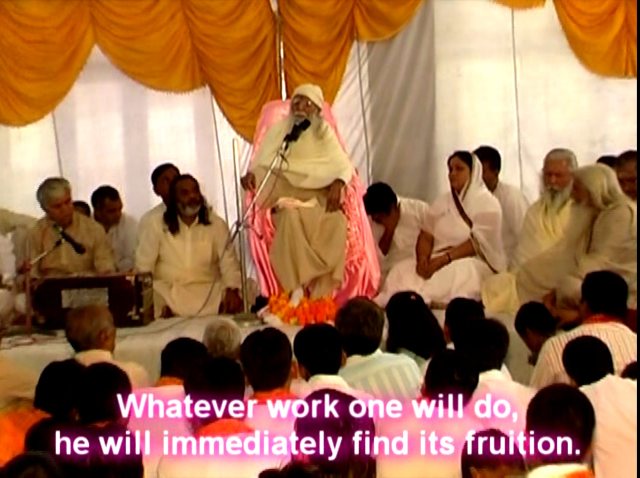
The mandate has come from above. It is not an order from some devotee, Paramatman has delivered that letter. Paramatman has revealed that letter. Whatever work one does, one will immediately reap its fruition. [A characteristic of the Parivartan cycle: the karmic result of one’s action – positive or negative – is rapid.] If he does not act, he will immediately meet with punishment, for each and everyone. Therefore remember, [the action of] the Parivartan will surely happen. Gurupurnima Message 2011].
At nighttime I weep, the whole night I find no rest. The body is very agitated. This can continue up to 8 a.m. when it’s time to get ready. Yet, what is it, nothing whatsoever. But Baba says it has to be like this. He sits, he acts, he has to bring the transformation.
The devotee, what can he do? Having become Parmatman, (once he becomes realized) he can do anything. From whatever country he can do so. Hence I told you about that verse from the Gita; everything is found in a single verse. I appeal to you that in the morning, for one hour, you should sincerely chant any name of Paramatman. Whether the mind likes it or not, just sit and do it!
Give Up the Love of Money
You think, “I am now great, I have a lot of money.” That money is nothing, you cannot take it with you. It will remain here. I saw that for marriages, you spent such a big amount of money. And when it’s time to make a donation, you ask yourself how much to give to Baba, or not give? Whose is it? Where did it come from? It came from Paramatman, and to Paramatman it should be given. Wealth is only to cover one’s needs. It should not be stocked in the bank. We receive so much money, yet we are always indebted. But to serve is our essential nature. What you eat, the saints also eat. There is never any money with me. He, the Supreme One is the owner of it all.
Therefore I will appeal to you to sit and do your sadhana, and whatever comes, you work with it. If someone arrives at your home, you serve him with whatever you can. Even if he’s a thief, what will he take? Your food? Therefore one should give to charities. This does not reduce your wealth. Whatever has been given to you, whatever comes, you pass it on. He who gives, has no lack of it. He keeps on giving, and he still has as much; Paramatman will see to it, so that is not a problem. I am under his shelter; He acts, He sees. He is the doer, He makes others act, He is the eater, and He is the one who serves. There is no one else, apart from Him. I never saw anyone else.
He inspires, accept His inspiration.
That much I shall say, my prayer will surely be fulfilled.
All devotees should chant Paramatman’s name for one hour. Sit and do it, whether you like it or not! Sit and chant, and you will start liking it.
The accumulation of experience, which is of such great importance, always reminds one of an example from early childhood. A child does not realize the properties of fire until it has burned itself. Of course adults smile superciliously at this example, but they carry on their own experiences by the same methods. Nothing will induce humanity to apply more sensitive methods. Of course, they will be astonished as to why the consequences of many of their misfortunes are so lengthy and poignant.
One may be certain that each action is considered necessary for redemption. This again is not a punishment but the acquisition of experience, and one can marvel at the precision of the scale of karma. There is nothing that can reproach this great balance. The corroboration of the tension of the cups of the scale depends upon the heart; it can overflow, uplift, and it can evaluate the worth of accumulations.
Thus, let people vigilantly watch their own vindication, which lies in the heart. It is not without cause that among the definitions of the heart there is also that of the vindicator.
🔶️🔶️🔶️
An experienced sailor frowns at a dead calm of the sea, foreseeing the gathering of a storm, and smiles at the blustering wind, perceiving a successful navigation. Of such a sailor it is said that he knows the sea. We say that he knows life if he knows how to understand the difference between the inner and outer manifestations. Some fools shout, “Rebellion!” when they hear the cry of a pottery vendor, and exult at the quiet when they see a closed market. Our way is to teach and to observe how different is the thought of dissolute people.
Classes for thinking and the observation of life processes should be established in schools. It may often be noticed that a child understands the hidden meaning of an occurrence better than an adult. Only according to inner feeling can we approach a just evaluation. We accept a calm surface before a storm, and we do not pay attention to the blowing curtains at the doors. Thus, the formation of events will be understood.
🔶️🔶️🔶️
Even the imagination is created by a lengthy experience of accumulations through the centuries, and all qualities of the spirit pertain to the same law. The quality of heroism must also be created and tempered in life. We do not casually remind you of the days of past heroism, at the hour when the firmness of the spirit must again be evidenced. We remind of how soon the valiant and invincible heroism must be manifested. Thus the accumulations of the spirit are awakened. How, then, can the realization of the beauty of heroism be created if it has not been justified by experience in life? How, then, can one affirm that heroism is beautiful, if the spirit remembers not the transport of the rays of achievement? What, then, can lift us above the chaos of mediocrity if not the wings of achievement? Thus, it is best when Hierarchy can evoke a spark of the very same feelings which formerly strengthened and uplifted the spirit. (Heart)
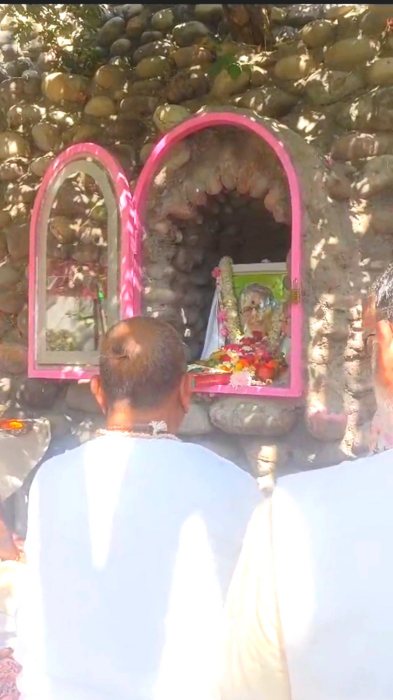
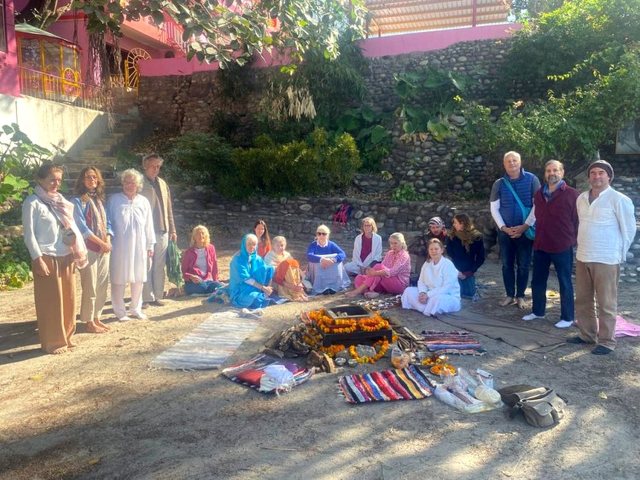
On Sunday April 13th 2025, a shrine for Shri ShantiMayiji, a Master of the Sacha lineage, was inaugurated at Sacha Dham ashram, in her garden. The puja (spiritual ceremony) was led by Pandit Tripathiji, one of Maharajji’s first disciples. ShantiMayi had peacefully left her body at 7:45 am on Sunday February 16th, 2025. Since then, there have been fire ceremonies, havans, prayer groups gathering all over the world offering ceremonies in gratitude and celebration for her, such as the Shodashi Shraddhanjali Samaroh – a Vedic commemoration of prayer, reflection and community offering in March.
Shri ShantiMayi’s house and garden at Sacha Dham ashram, 2024
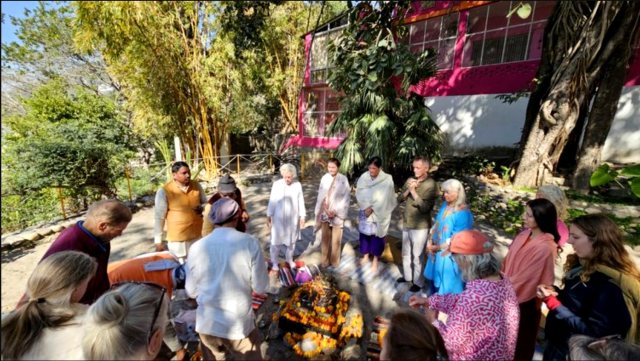
Havan ceremony with ShantiMayi 2024
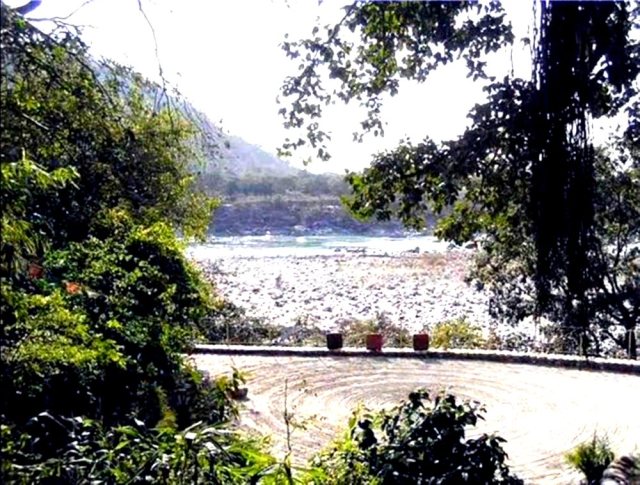
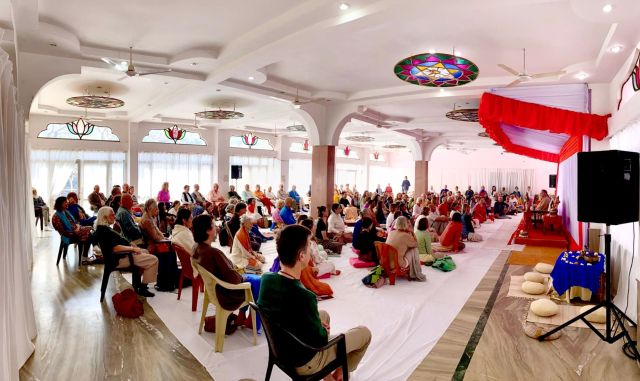
It was there that many of her early satsangs took place, before being held in the ashram’s satsang hall. Her garden is home to so many spiritual ceremonies that the peaceful vibrations there are strong. In one part of the garden there is a mandir for Lord Ganesha, while the big space in front of the house, overlooking Ganga (the Ganges) saw her early satsangs and pujas.
Puja ceremony for Lord Ganesha, 2001
Saint Hans Raj Maharajji Sacha Baba, her Master tells us that after four years with him, and her enlightening experience, ShantiMayi, through an inner voice, was told by Sacha Baba to travel to different countries and through him (Sacha Baba), bring his energy to the people. So she told Maharajji, and surrendered to him. According to him, when she started this work, the first time she travelled to eleven countries, and the second time, twenty-two countries. And each time more and more disciples came to the ashram after her visits.(Interview with Maharajji (1999) – Jivanjili)
Sacha Dham meant far more to ShantiMayi than simply “her Master’s ashram”, for according to Saint Hans Raj Maharajji, the ashram was built to assist the Spiritual Regeneration of the world, (Shift in consciousness, Parivartan) to provide a source of light for sincere seekers, “… a center in Uttarakhand, which will be a pillar of light for the whole world.” (Saint Sacha Baba Kulanandaji).
On 13th and 14th March 2025, a special ceremony was held at Sacha Dham Ashram in Tapovan, India to honor the sacred life and teachings of Sri ShantiMayi Ji at the Shodashi Shradhanjali Samaroh—a sacred commemoration of prayer, reflection and community offering. This is a Vedic tradition held 16 days after the beloved Master’s cremation.
In the morning on 13th March, a sacred Havan Ceremony took place in the ashram’s Yagya Shala (fire hall). This was followed the next day by a Bhandara 1 and Remembrance gathering, consisting of bhajans and the sharing of stories and teachings of Shri ShantiMayi Ji. ———————————–
1 Agape or large religious meal shared by several people as a sign of love and brotherhood, often after certain religious ceremonies.
🟢🟢🟢🟢🟢🟢🟢
ShantiMayi’s garden, on the bank of the river Ganga
A havan ceremony for ShantiMayi 2025
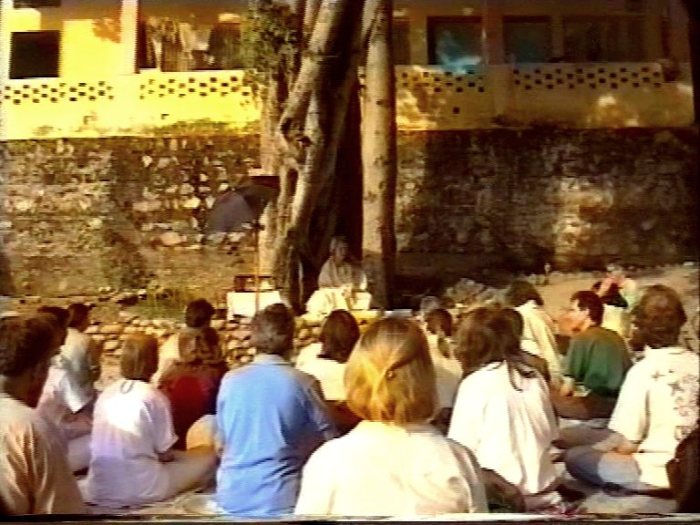
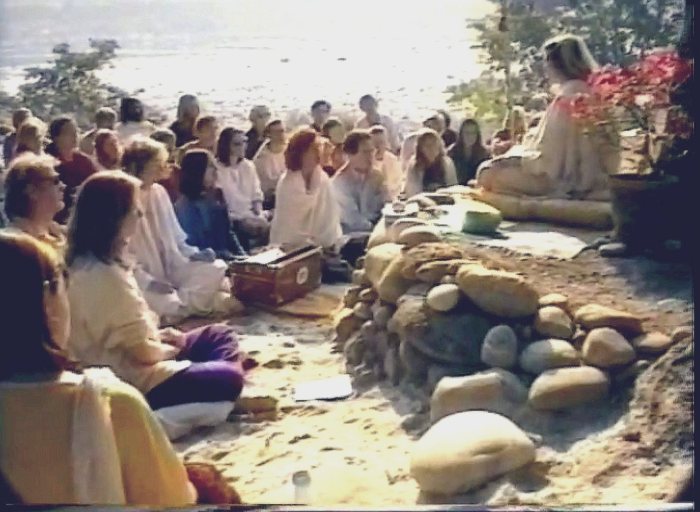
Early satsangs
ShantiMayi at Sacha Dham in 2024
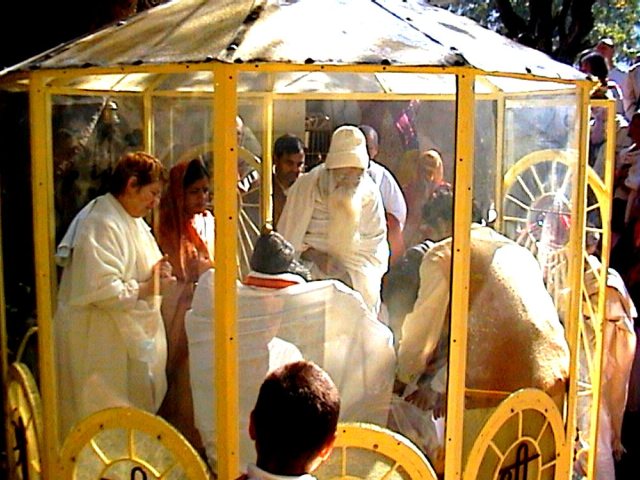
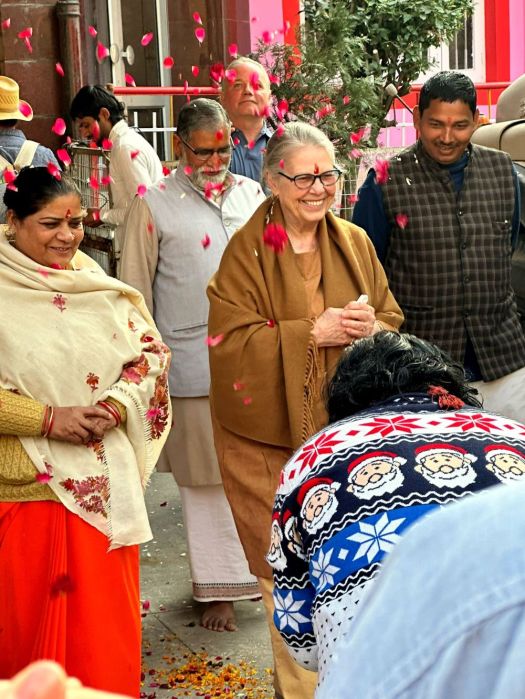
ShantiMayi arrives at the ashram. On the left is Anitaji, Mataji
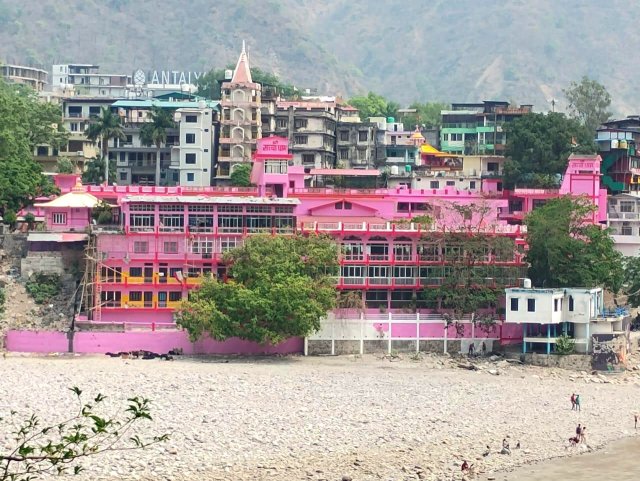
The ashram being repainted, supervised by ShantiMayi
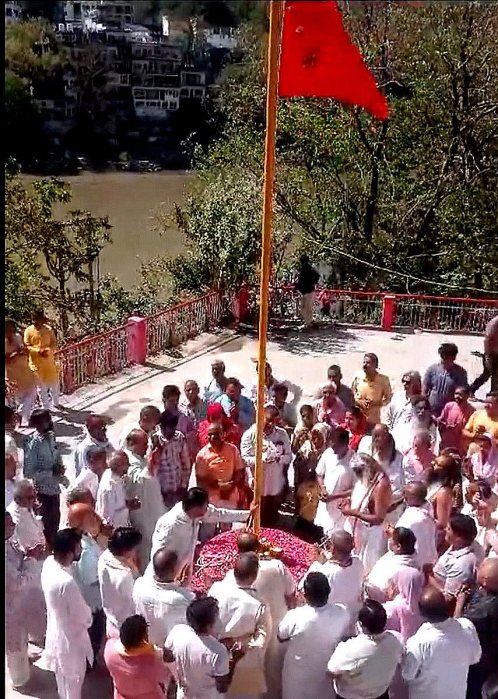
April 13th is a special day for Sacha Dham ashram, for on that day is celebrated its founding, and also, the ashram renews its pledge to assist humanity in its upward march to a higher state of consciousness. So it was that the ashram’s flag was hoisted in the morning of 13th April 2025, at the start of a new spiritual year. It symbolizes the spirit of the dawning era, and the new energies which are now shaping our consciousness in this period of the regeneration of the world. Sacha Dham, which celebrates both events every year with a festival, is dedicated to assisting this process, and was created in the 1970s for that purpose.
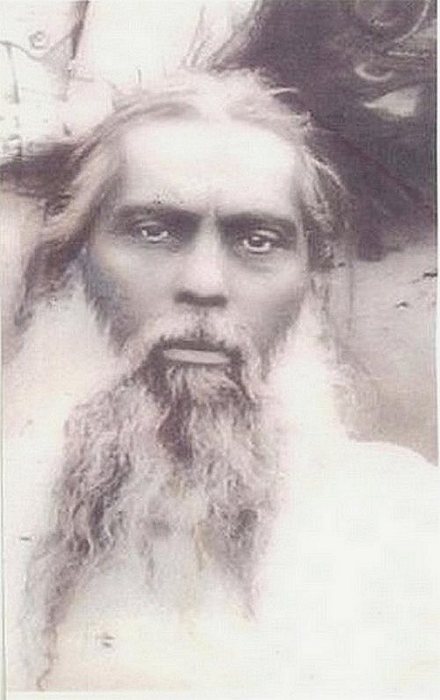
It was Shri 1008 Sacha Baba Sant Girnari who, in 1936, revived the tradition of hoisting this flag, after a gap of nearly fifty-two hundred years. (From Mahatma Gandhi to Saint Sacha Baba, by Diwakar Singh, ADHYATMA, Year 34, Special Issue (1-2).)
When he succeeded Saint Kacha Baba as president of the Parliament of Saints – the Fakiri (Saint) Parliament, he laid the foundations for the new cycle of activities to assist the Shift in Consciousness, or Parivartan. The hoisting of the flag of the Parliament of Saints,, which was the same one (a copy) that was raised by Lord Krishna in the battle of Kurukshetra, signalled the fact that the Kali Yuga energies were ending, giving way to the new ones, and that the spiritual Hierarchy of Masters were actively assisting humanity in its upward march to a new cycle of consciousness. To salute this flag, which carries a power of Regeneration, means that one has decided to “conform to the truth and place oneself under the flag of God, and so embrace this Regeneration”
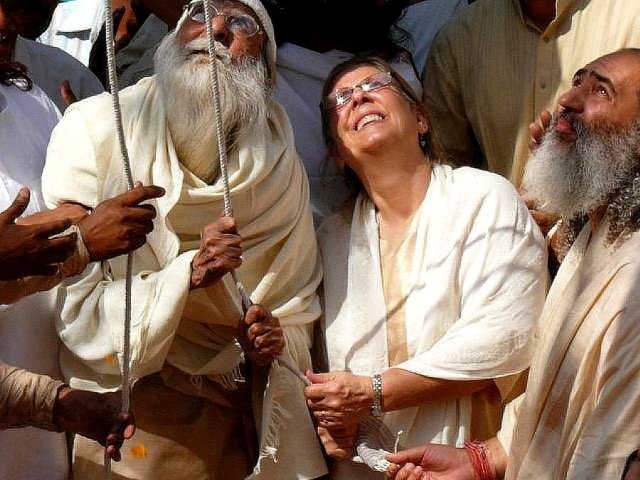
On previous occasions, the flag was at times hoisted by three Sacha Masters: Saint Hans Raj Maharajji Sacha Baba, Shri ShantiMayi and Shri Prem Baba.
Love is one of the forces of God, and as the cohesive energy, it binds the universe into an intelligent working unit. In man, this energy propulses him upwards in his strivings to realize the Self (God in man), and at the same time is manifested in different aspects of his life in several ways, particularly as a uniting element. The very interesting article below (extracts) sheds light on how love helps us and in many ways shapes our lives.
The Saving Force
by William Meader / March 17, 2013
As we look at the current state of the world, it can easily feel like civilization is coming to an end. All around us we see suffering, pain and strife. Racial, ethnic and national divisions are globally inflamed, and separateness seems to be the order of the day. Seeing this, it is easy to believe that humanity is on the brink of disaster, and that we are witnessing the prelude to another Dark Age. Yet these problems are not without remedy. The realization of our essential oneness is the antidote, and it is love that makes such realization possible. Love has therefore been called The Saving Force.
Love exists as a pervasive energy underlying human existence, and never waivers. It is the force that reminds us of our fundamental oneness. And, it is this realization that human evolution is tending toward. Yet love is not something that must be developed, but only discovered and lived. It pre-exists. Indeed, we do not cultivate the saving force of love. Instead we cultivate our capacity to recognize and embrace it.
Often people say that God is love, and indeed, there is much truth to this notion. Though God is characterized as possessing many attributes (such as will, beauty and intelligence), love is the most important. It is a vibration woven into the fabric of Creation itself. Love binds all things together in a field of unity. From the human perspective, when two people fall in love, they are both immersed in this unitive energy. Taken more broadly, it is the force that helps humanity to realize its oneness. And, from a cosmic perspective, it is the binding energy that holds the universe into a working singularity. Whether we consider it from a human perspective or beyond, love always attracts and unites, and in this is found its saving properties. It saves by uniting, and dissolves the barriers that divide.
As we consider this subject, it must be realized that love is hierarchical. By this is meant that love can be experienced at varying levels. At the lowest level, it manifests as desire. Our cravings, wants and longings relate us to love at a very personal level. A higher category of love is aspiration. Here love is the force that propels us toward something that is meaningful. For example, when we see a scientist aspiring to find a remedy to a terminal illness, we are witnessing love in action. Often with aspiration, there is a personal and impersonal aspect to it. The scientist will likely experience personal satisfaction from the discovery of a medical cure. Yet, he is also impersonally driven to contribute to the betterment of humanity through the field of medical research. On a still higher level, love is directed toward the oneness of humanity. In this case, the love of humanity is all that is known, and there is no personal benefit that gives rise to this experience. Indeed, the highest type of love is the most impersonal, and yet the most inclusive.
When a person is relating to higher love, solutions to problems become more apparent. In this regard, love can be considered revelatory. Often problems seem irreconcilable because there is a lack of understanding between the parties involved. Yet, when a person holds a sense of loving unity, the barriers that prevent finding a solution begin to dissolve. Love can lift the veils that tend to prevent us from seeing the way out of a conflict or crisis. This is because it makes it possible to more easily recognize ourselves in those who hold an oppositional view. When such a sense is established, we then can better comprehend the reasoning behind the opposing point of view. In truth, this is an essential step in finding a solution to any problem or crisis. Understanding thus emerges, and in this, solutions can be found. Understanding is therefore the agent of love. […] It may well be asked, how does one distinguish between higher and lower love? As already mentioned, higher love is more impersonal than the form of love usually experienced by people. Higher love does not want for itself. By this is meant that it requires no reciprocation. Typically when we experience love, it is accompanied by the hope of love in return. Therefore, the usual experience of love is rooted in a hidden yearning to be loved. In this regard it is reciprocal. Yet higher love doesn’t behave in this way. There are no strings attached to its expression, for it is sufficient unto itself.
In addition, lofty love is free of the attitudes that arise from the judgmental mind. These types of thoughts tend to divide life into categories of right and wrong, good and evil. Higher love finds no room for expression when the mind is focused on such divisions. These mental tendencies often preoccupy the ego (personality), thus blocking love from its expression. Love is always present though difficult to access when the mind divides and separates what it perceives. In this is found a deeper understanding of the ancient notion that the mind is the “slayer of the real.” Yet, when the mind is properly wed to love, it acts as the “revealer of the real.”
It is important to realize that higher love transcends all personality reactions and judgments. To experience this type of love requires, therefore, that an individual be profoundly removed from his personality. Indeed, we must inwardly know ourselves to be the Self, and realize that the personality is merely an outer garment for its expression. When this is at least partially realized (experientially) then a higher type of love will surely be felt. […]
The evolution of human consciousness is profoundly connected to love, and our changing relationship with it. Indeed, the expansions of the mind (spiritually understood) only occur because there is a widening intimacy of the heart developed at the same time. Several methods can help enhance a person’s relationship to love. Most important of these is to work toward perceiving life and events in terms of the larger whole. In other words, try to recognize those things that remind us of our commonality and oneness. By so doing we counter the mind’s separative tendencies. The spirit of criticism and division wanes when one cultivates an inclusive perspective to life and circumstance. In this way, higher love gradually becomes more recognized and felt within one’s life.
We have seen that love is The Saving Force. This sacred energy has the power to lift humanity by revealing the fact that we (as a species) are essentially one. This awareness gradually develops as an individual deepens his relationship to love. In this regard, love is hierarchical. At its lowest level, it manifests as personal desire, and at its highest point is experienced as inclusive love dedicated to wisely contributing to humanity’s betterment. Our relationship to love is therefore evolutionary. It evolves from personal to impersonal expressions of the heart, thus shifting an individual from an exclusive to an inclusive relationship to life. Love is not something that must be created for it always exists. We need only to find it deep within ourselves. And, to do so always requires that the personality (ego) yield to the deeper love conveyed by the heart. In truth, higher love is only realized when we surrender to it.
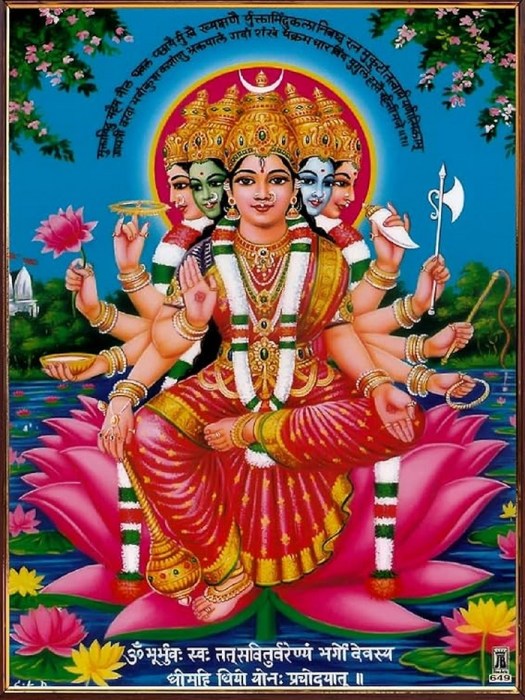
To listen to the tones of the Gayatri Mantra is like taking a dip in the Ganges. It is soothing to the entire nervous system. One feels cleansed and drenched in simplicity.
There is a contemplative quality in the midst of the Gayatri’s vibrations. It is similar to walking alone, along an ocean shore. It brings us ever so deep into the silence of our heart, like holding the hand of a newborn baby. There is something in the sound that touches us, that soothes us, that involves us, that arises from deep within us, in an enigmatic way. This is the power of listening to and chanting the Gayatri Mantra.
There is an infinite succession of voices reaching back through the ages that have chanted the mantra for the whole of existence. It is the Gayatri lineage. This timeless lineage surely intensifies the magnetic attraction people feel upon hearing this wonderful mantra.
The Gayarti Mantra is a prominent verse in the eternal celestial song and is mentioned in the Bhagavad Gita (Celestial Song). In the tenth chapter, Krishna says:
“Of the Vedic Hymns, I am the Gayatri.”
In other words, this mantra is the mother wisdom verse of I am.
When asked about the spiritual effect a mantra has on the chanter, Ramana Maharishi simply answered:
“There is nothing that can surpass the excellence and effect of the Gayatri mantra.”
Upon hearing the mantra, one is moved by its great capacity to express a genuine and flawless message of awakening for all. When chanting, or listening, or both, one is filled with this subtle message, as it vibrates in our breath, heart, blood, bone and brain. Extract from Gayatri Mantra book, by ShantiMayi.
Shri ShantiMayi peacefully left her body at 7:45 am on Sunday February 16th, 2025. At this time, there are fire ceremonies, havans, prayer groups gathering all over the world offering ceremonies in gratitude and celebration for ShantiMayi, this Great Soul who devoted her life to uplifting our world.
Shri ShantiMayi is a Master of the Sacha lineage, a disciple of Saint Hans Raj Maharajji Sacha Baba (affectionately known as Maharajji). She followed in her Master’s footsteps and so dedicated her life to working in the Universal Soul to help humanity raise its consciousness, and be prepared as much as possible for the Parivartan or Universal Shift in Consciousness which is ongoing.
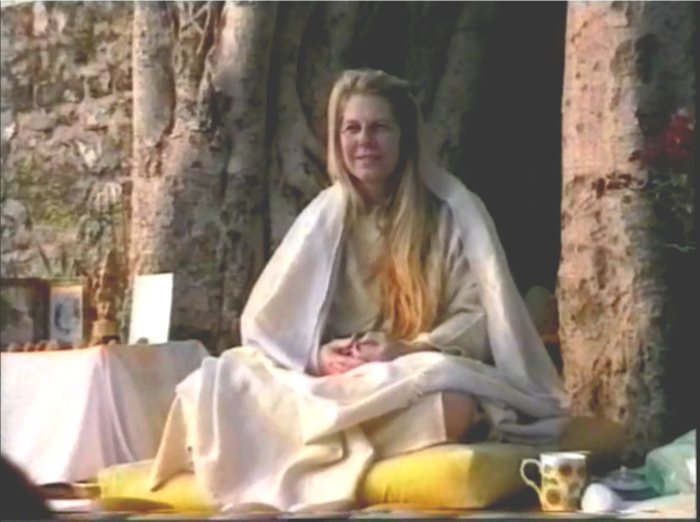
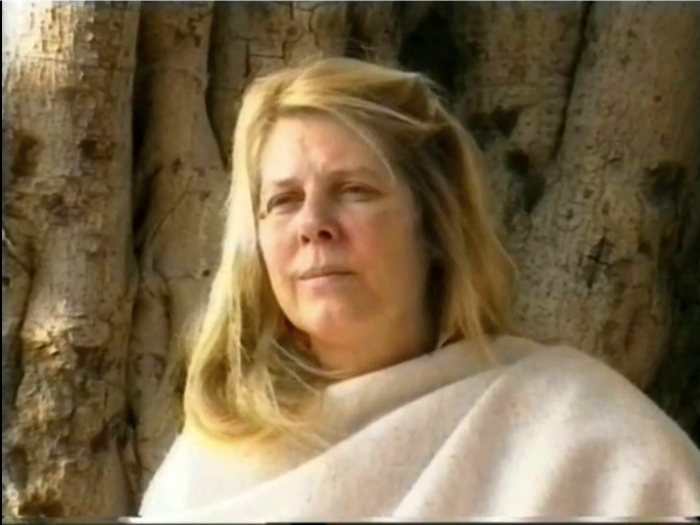
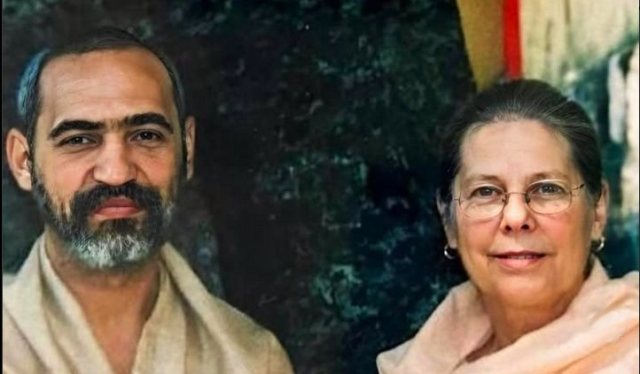
Shri ShantiMayi
Yes, she has gone Home, but she will be back, for this Great Soul belongs to the category of Enlightened Beings who have chosen to come back again, and again, and again, until the last human being has become enlightened.
The Sacha lineage, in working for the enlightenment of all beings, has had a physical presence in India in each age. And little by little, the disciples of Sacha began to move their presence out into the rest of the planet. ShantiMayi, the first Westerner of this lineage, has thousands of students spread throughout the world. Her ashram is located in the French Pyrenees, but by 2008 her students had already brought Sacha all over the world, through many active Sacha communities in Europe, Australia, North and South America, and Africa, and with her have now established some ashrams.
How Did it All Begin ?
Guided by her heart, after bringing up her family, ShantiMayi, went on a spiritual quest, and eventually found herself at the feet of the guru who was recommended to her – Maharajji. In the extracts below, in very moving terms, she speaks about the bond which was formed between them from the very first visit, which stayed strong, and was never broken.
There on his veranda he sat with a few people around him. I looked at him and my heart fell to earth. It was as though the light in my heart melted into a pool at his feet. There it stayed, it was his. My God, I met him only a minute ago, and already he had taken my heart for ever. I looked deep into his eyes and raised my face eye to eye with his. Filled with an overwhelming humility, these words, “I want to be just like you” passed my lips. Looking at me as though I was not really there, yet straight into the depths of my being, he said “You will be.” I knew then I would never leave him. I never have left him, not even for a second.
(…)
As I sat outside his door day after day, his prayer for humanity poured grace over me. Each day, I could see more and more clearly what his Guru wanted from him. He sat by himself in silence, communicating in an incomprehensible way to the deepest receptivity in Consciousness, that all beings must awaken. He has given his life to it and he has asked the same of me. Each day, his day is still filled with the command of his Master and each day is filled with our Maharajji’s way of serving existence.
And so it was in 1988 as I sat with him in silence and he looked at me with flashing eyes and said “Some day you will wear my shoes.” I didn’t know what it meant so I tucked it into my heart and left it as a secret to blossom as it may. The Guru’s word always bears fruit at one time or another. It always bears fruit. [Extract from ShantiMayi’s story, published in 1998 (special issue) in the German magazine Wegweiser.]
On leaving the ashram after that first visit in 1988, Maharajji asked her spend six months every year in the United States to earn enough money so as to come back and live at the ashram for the other six months. He also asked her to give something to the people. In 1990 on my first visit to Maharajji at Sacha Dham, I (the author) found three letters from an American devotee – ShantiMayi – in the ashram magazine I was given, where she mentions the spiritual teachings she gave at the university in Oregon, called Self Development and Self Actualization. Those were her first satsangs.
After reading about her meeting Maharajji, and also one of the letters, below, we sense how eager ShantiMayi was to start her mission, which her heart knew about and remembered long before her mind did. Four years later, she had the experience of Enlightenment.
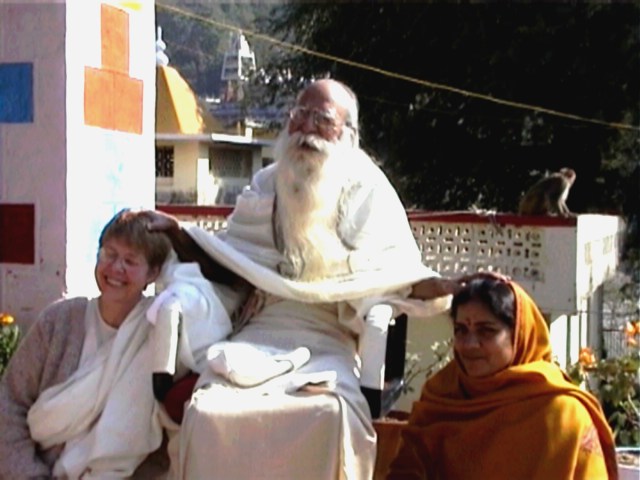
Maharajji, ShantiMayi and Mataji
Letter to Maharajji From an American Devotee
2nd June, 1989
Om Shri Maharajji,
I lay my head to your feet, and touch your feet to my heart. I hope this letter finds you in good health.
Our satsang in the university has started, and we felt your presence very strong. Everyone was pleased with the satsang, and everyone felt your love. It was very powerful. Each week it will get better and better.
I feel you know everything that happened in the satsang. Meeting with these people was the greatest joy I have found since leaving India.
Sometimes I think that writing to you is foolish, as you are always with me. But it is like a darshan, for I know that at sometime you will touch this letter and read it. It’s still like adding another link…
It is very difficult always being with people who are very materialistic. No japa, no meditation, no real love of God ! As I always say in my letters to you, I want to come home very badly. One night I stood before you in a dream, I pointed my finger to the sky and said loudly, “I will never leave Sacha Dham again ! unless you send me away.” Really, I am always there, I have never really been in the U.S.A. yet. I carry you in my heart so powerfully that people see you in my eyes…
Remember Guruji, every Friday morning at 8:00 am, we have satsang in your honour. I’m sending a rose from our first satsang from your puja there. I’m working hard many hours to return, and before I return, I will have given your compassion to many Americans who are very attracted to your love.
I’ll write again soon. My Holy Guru, you are my most joyful thought, my greatest inspiration.
Your devoted, ShantiMayi.
ॐ ॐ ॐ
Our deep Gratitude and Love, to you, Beloved ShantiMayi !
May your teachings of love and compassion for all life continue spreading like the rays of the morning sun at dawn, dispelling the darkness of ignorance.
Following your example, as long as space remains, as long as sentient beings remain, may I too remain to dispel the sufferings of this world.
ॐ ॐ ॐ
Shri ShantiMayi and the Sangha sing Prabhu Aapa Jago
🟣🟣🟣
Shri Prem Baba: Tribute to Shri ShantiMayi
Tribute to ShantiMayi
Today, my heart is filled with gratitude and reverence as I honor the life of a great woman who left a unique mark on the mission of my spiritual lineage, the Sachcha lineage. ShantiMayi was a true pioneer, paving the way for many to access the doors of the hall of truth. I received the news of her passing with a deep emptiness in my chest—a space that, despite her physical absence, will remain eternally filled with the love and significance she had in my life.
ShantiMayi is my spiritual sister. A disciple of Sri Hans Raj Maharajji, just like me. It was through her channel that I found my way to my guru, and for that, her presence in my journey will always be a reason for gratitude. When I went to India for the first time, I already felt in my heart—through spiritual visions—that I should go to Rishikesh. But it was still in Pune, at Osho’s ashram, that I heard about an American master who welcomed Westerners in Rishikesh. I felt I should meet her.
Upon arriving at Sachcha Dham, she was leading a Satsang. My heart opened, and I thought, “This woman can help me find answers to my questions.” The next day, I went to see her, but she wasn’t there. And at that moment, I met Maharajji. In other words, ShantiMayi was the bridge that led me to my guru.