
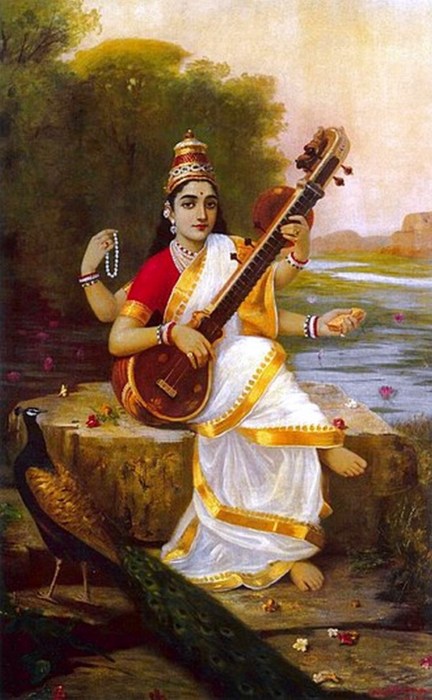
The Sarasvati river had been honoured for thousands of years in the context of the Vasant Panchami festival in the Hindu religion. Book 6 of the Rig Veda includes a hymn called the ‘Nadistuti Sukta, which sings praises of the Sarasvati as being “perfect mother, unsurpassed river, supreme goddess”. However, today its spiritual greatness as a river is no longer well-known and in general it is no longer included in the Vasant Panchami celebrations. The attention is now focused exclusively on the goddess aspect of Sarasvati, forgetting that she also used to be worshipped as a river. Sarasvati river is remembered today in connection with the sacred Triveni Sangam in Prayagraj (Allahabad) to which, as a holy river, it flows underground to merge with the other two sacred rivers, the Ganges (Ganga) and the Yamuna.
Sarasvati therefore has radically changed direction and instead of flowing west to the Arabian sea, it said that it now flows east to Triveni Sangam. Today, some people are puzzled by what is said of the river: as a powerful river how could it have dried up, leaving no clear path to show where it once flowed? Did it really exist, or is it just a myth? Many attempts have been made to find the old path of this river. Also, if it has dried up, why is it still very important? Could it be that Sarasvati’s changing course has some signification for Man’s progress in his quest to find his true nature?
Vasant Panchami is dedicated to honouring Goddess Sarasvati, the Hindu goddess of knowledge, music, flowing water, abundance and wealth, art, speech, wisdom, and learning. She is one of the Tridevi, (Trinity of supreme Divinity) along with the goddesses Lakshmi and Parvati. The festival is also celebrated to welcome the spring season.
Vasant Panchami or Basant Panchami falls on the fifth day of the bright lunar fortnight (Sukla Paksha) of the month of Magha in the Indian lunisolar calendar. This corresponds to the months of January and February in the Gregorian calendar, on February 2nd of this year (2025).
It is celebrated every year at Sacha Dham ashram, as it is elsewhere India. Vasant Panchami marks the beginning of the transition period from winter to spring. After Makar Sankranti (January 14), the sun gradually starts its northward journey from the tropic of Capricorn as winter gradually fades away, leading to warmer days. After this transition period of around 30 days, starting from Vasant Panchami, spring comes into full bloom around the time of Holi.
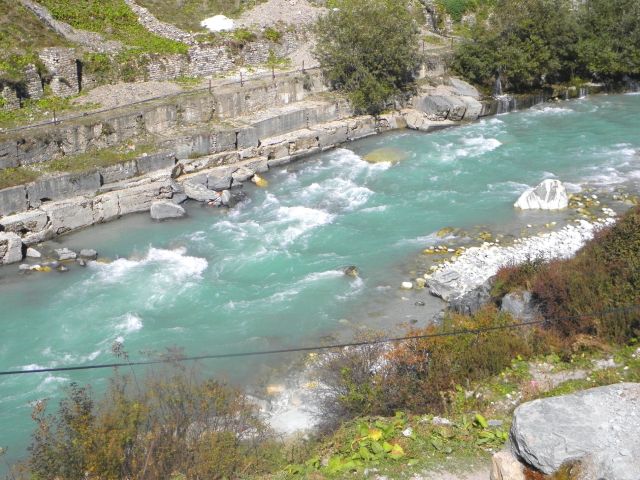
In ancient times, Vasant Panchami was also the festival of the river Sarasvati, an ancient river in northwest India. Originating in the high Himalaya, the Sarasvati is believed to have descended to the plains, and then dried up in the course of time. In many parts of India, this festival is known as Sarasvati puja, a day to honour Goddess Sarasvati. In the ancient Indian scriptures, primarily the Rigveda, it is extolled as a mighty river flowing from the mountains to the ocean. It is mentioned over 70 times in the Rigveda, signifying its vital role in the lives of early Vedic people. It is said that superimposed on the Vedic Sarasvati river is the “heavenly river”: the Milky Way, which is seen as “a road to immortality and heavenly after-life.“
In those early Vedic times Sarasvati was worshipped as a river goddess, whose stream played the same role for the ancient Aryans of the Punjab as the Ganga was later to play for so many on its plains. West from the Himalayas she flowed, to be celebrated for her purifying and fertilizing powers and because her length continued all the way to the Arabian sea. When the ocean god, Varuna, stole the wife of Utathya, the incensed Sage pronounced a curse upon the river’s flow in order to deprive Varuna of receiving his bounty. Thus, as the Mahabharata tells us, Sarasvati became lost in a sandy desert, forced underground, where she secretly meets the flows of the Yamuna and Ganga. Extensive research has confirmed that the river had really existed, and that with time, changes in the river’s course, possibly due to tectonic activities or climate changes, led to its disappearance or underground flow in parts of its trajectory, significantly impacting the civilizations it once nurtured. Several present-day rivers, including the Ghaggar-Hakra, are considered remains of the mighty Sarasvati.
But before this time, Sarasvati was closely identified with the sacred rituals performed by priests along her banks, leading to the popular belief that she had influenced the composition of hymns chanted there, that her rhythm and melodious voice had even inspired the Sanskrit language in which they were uttered, and ultimately inspired the Vedas themselves.
Thus she came to be called Mother of the Vedas, and even as her current became invisible, she slowly acquired more of the characteristics associated with Vach. Just as Vach, as river goddess, had supplied life in the form of water to the world, so Sarasvati, assimilating the powers of Vach, became the supplier of spiritual life in the form of the sacred knowledge of the Vedas. The analogous roles became one, and as Sarasvati lost her prominence among the Sapta Sindhus (the seven sacred Vedic rivers), she assumed the more glorious role of divine nurse and goddess of eloquence, wisdom and learning.
Since then, the Sarasvati river exists in a metaphysical form, in which she forms a confluence with the sacred rivers Ganges and Yamuna, at the Triveni Sangam in Prayagraj (Allahabad). One thing we know, is that this sacred river “got lost” because her path was no longer the right one, and so she had to “get home” by changing direction. And she succeeded. This experience of the Sarasvati river could have deep significance for human beings and it is up to us to find out what that is.
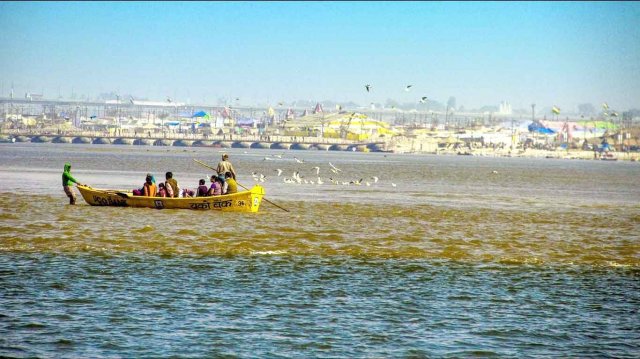
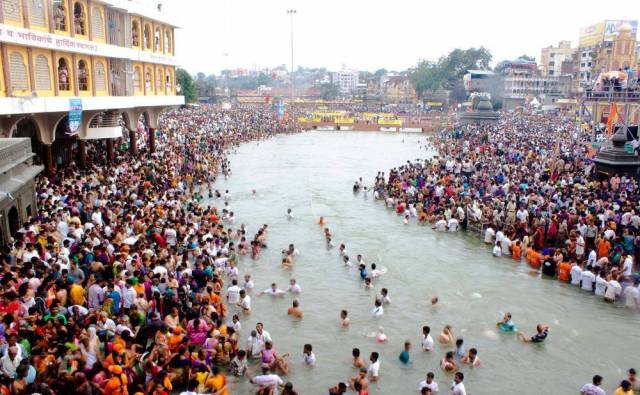
The Triveni Sangam is believed to be the place where drops of Nectar fell from the pitcher, from the hands of the Gods. So, it is believed that bathing in the Sangam will wash away all one’s sins and will clear the way to heaven. Devout Hindus from all over India come to this sacred pilgrimage point to offer prayers and take a dip in the holy waters. The Kumbh Mela, an extraordinarily fortunate celebration, is held here once every 12 years, and the Ardh Kumbh, an equally auspicious event, is once every 6 years. This year (2025), the Maha Kumbha Mela will take place from January 14 to February 26. The celestial alignments during this time are believed to amplify the spiritual energy of the location, making it an auspicious period for prayer, meditation, and self-purification.
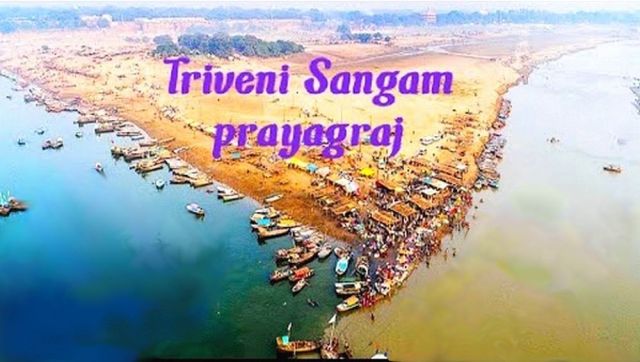
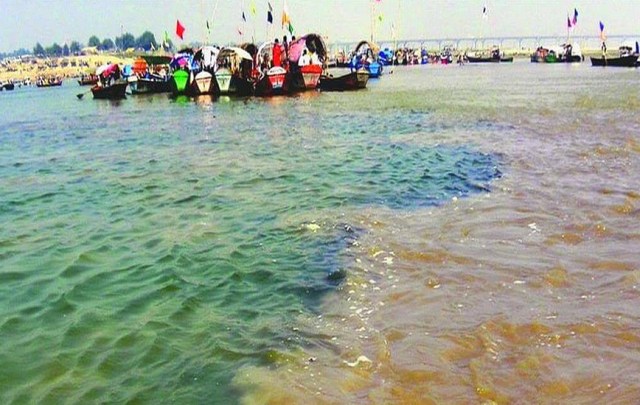
The three rivers maintain their identity and the two we can see are visibly different as they merge. While the Yamuna is deep but calm and greenish in colour, the Ganga is shallow, but forceful and clear. The Saraswati remains hidden, but the faithful believe that she makes her presence felt underwater. The distinct colours can be seen at the confluence.
It is said that Lord Shiva resides at the confluence of these three sacred rivers also known by the names Shulatanka and Someshwara. The rivers encircling the city of Prayagraj inspired Lord Brahma to select this tract of land for the first universal sacrifice.
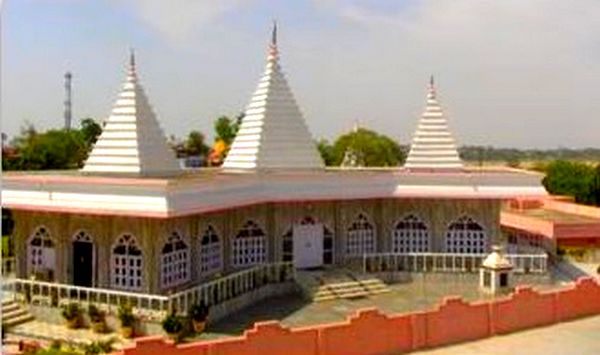
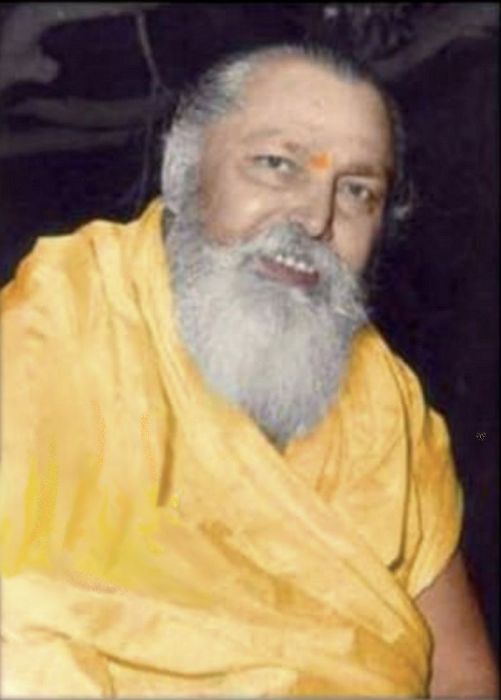
A Master of the Sacha Lineage, Saint Sacha Baba Kulanandaji, Avatar of both Lord Vishnu and the Rishi Narada. founded Shri Sachcha Baba Ashram at the confluence of the three sacred rivers in 1953. It lies on the road running beside the Yamuna and faces the Triveni Sangam in Arail. He also had another ashram founded by his prominent disciple, Saint Hans Raj Maharajji Sacha Baba in the 1970s; This Avatar, Saint Kulanandaji, carried out such great work that he brought humanity closer to God, and left important tools that man can use to become a realized being.
🟡 🟡 🟡 🟡 🟡 🟡 🟡


 The Call of the Heart