
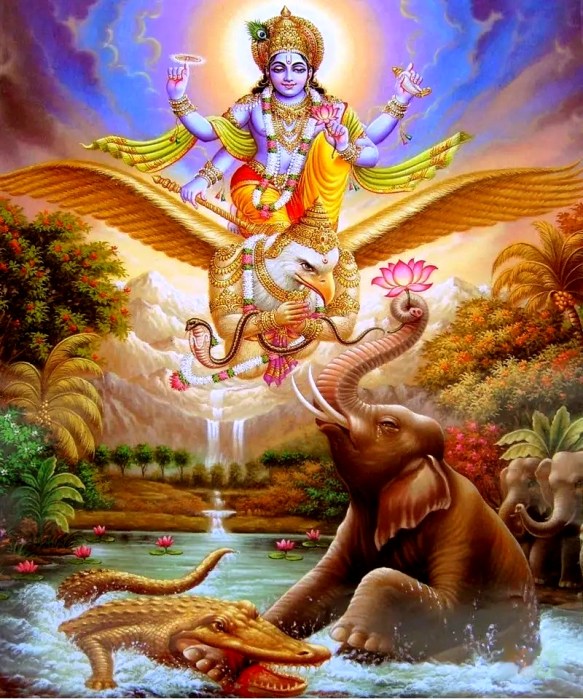
Vishnu rescues Gajendra
In the first part, we saw how the disciple Indradyumna’s (the lower self’s) consciousness gradually gravitates away from that of the higher Self and he was no longer apt to live in the the high spiritual realms. We will see in this second part how he strengthens his link with the Divine, and finally lives as the higher consciousness once more, thus reaching his spiritual goals.
Let us remember that everything happens in the inner world of the disciple Gajendra. The struggle to reach the Light and be wholly one with God happens in our consciousness. Maharajji (Shri Hans Raj Maharajji Sacha Baba) once said, “You will be rewarded according to your deeds. Now come to your senses. God will free you of your karma. He is not at all outside you. He is inside. Inside you there is hell, heaven and devaloka. Everything is inside. It does not make any difference if you are a Hindu or a Muslim.” [Prakash Diwash Message 3 Oct 2008]
THE TALE
There was once an elephant named Gajendra who lived in a garden called Ṛtumat, which was created by Varuna. This garden was located on Mount Trikuta, the “Three-Peaked Mountain”. Gajendra ruled over all the other elephants in the herd.
One day, as usual, he went to the lake nearby to pick lotus flowers to offer prayers to Vishnu. Suddenly, a crocodile, Makara, (or Huhu) living in the lake attacked him, and caught him by the leg. He tried for a long time to escape from the crocodile’s clutches. The whole herd, relatives, and friends gathered around to help him, but in vain. The crocodile simply would not let go. When they realised that ‘death’ had come close to Gajendra, they left him alone. He trumpeted in pain and helplessness until he was hoarse. As the struggle was seemingly endless, when he had spent his last drop of energy, Gajendra called on his deity Vishnu to save him, holding a lotus up in the air as an offering.
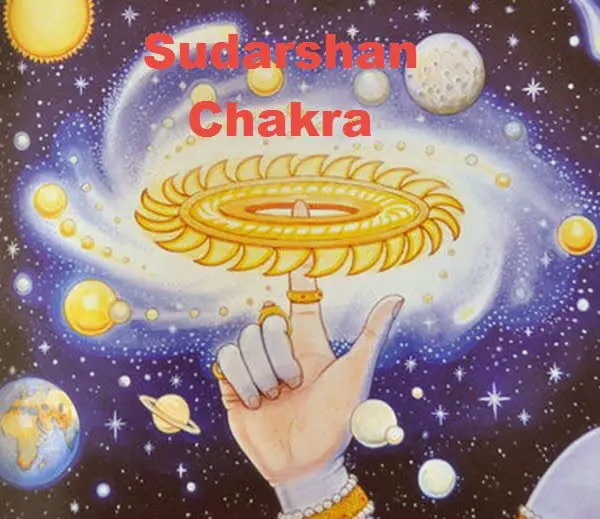
Hearing his devotee’s call and prayer, Vishnu rushed to the scene. As Gajendra sighted the god coming, he lifted the lotus with his trunk. Seeing this, Vishnu was pleased, and with his Sudharshana Chakra, he decapitated the crocodile.
Gajendra prostrated himself before the deity. Vishnu informed him that he, in one of his previous births, had been the celebrated King Indradyumna, a Pandyan King (modern day Tamil Nadu) a devotee of Vishnu, but due to his disrespect to the great sage Agastya, he had been cursed to be reborn as an elephant. Because Indradyumna had been devoted to Vishnu, the deity had had him born as Gajendra. He made him understand the concept of Kaivalya, which was beyond Svarga (Indraloka) and Urdhva Loka, the realm of the gods. Indradyumna was to attain moksha when he (as Gajendra) left all his pride and doubt, and totally surrendered himself to Vishnu.
🔴 🔴 🔴🔴 🔴 🔴 🔴
THE SYMBOLS
Of course we will bear in mind that spiritual stories have several levels of meanings, and so there is no single interpretation. The symbols reveal themselves differently, even to the same person, depending (among other things) on their interest, sincerity and state of consciousness at a particular time. For example, the symbol of the “elephant” was not chosen by chance; different meanings will therefore be presented to the consciousness of different people. Our subconscious mind recognizes certain truths in these tales, and when solicited, will send up to the forefront of our thoughts specific ideas, not necessarily immediately, but over a period of time, more or less short…long.
● Vishnu
Vishnu is God, Maintainer of all that is. Everything is contained in Him, and He is in everything. He is linked to the soul and consciousness. Vishnu is also the spark of God in man (usually known as Brahman according to the Upanishads) – the Atma, the higher Self, which was not created, is divine and eternal. The Atma – God in man – remains in God and can never leave.
● Varuna – He symbolizes the higher Manas
▪︎ Manas (the Mind, Intelligence) is the thinker, the actor, and the creator and experiencer of Karma. The lower manas is our present personality, our personal (lower) self, while the higher Manas is our permanent individuality, our individual self belonging to the divine world. This higher Mind, as part of the essence of the Universal Mind, is unconditionally omniscient.
▪︎ In the tale, Varuna, the higher Manas is never mentioned, except when we are told that Gajendra, the disciple, lives in a garden created by Him. So we easily understand that he is under His direct rule. The disciple does not know Him, he only knows Vishnu, the Atma. However, Varuna is his higher Mind, his “better half”, and little by little, He communicates His love and wisdom to Him. Whenever Gajendra, the lower mind raises his consciousness, he may remember some of what filters down to him as intuitive thoughts, premonitions, “vague undefined reminisciences”, visions etc;
▪︎ In reality, there is only one Manas, which is a part of the Divine triad in Man, the higher consciousness, along with Atma (the higher Self – universal) and Buddhi, (His vehicle – Universal Soul), all three of which are eternal. But since its vibrational frequency is of such a high nature that it is impossible for it to incarnate, function, or manifest directly here on the physical plane, it functions there as the lower manas or mind. There is practically no communication between them, because of the great difference in the frequency on which they function.
▪︎ Just as the deva (angel) Varuna of the divine world comes just after God (Shiva, Vishnu, Brahma) in the hierarchy of divine beings, as one of the seven sons of Aditi – the Great Architects of the Universe (or in Christianity the seven Spirits before the throne of God – Archangels) who watch over humanity, in the same way in Man the divine higher Manas, Mind, comes just after God, (Atma-Buddhi), and is in charge of the lower self.
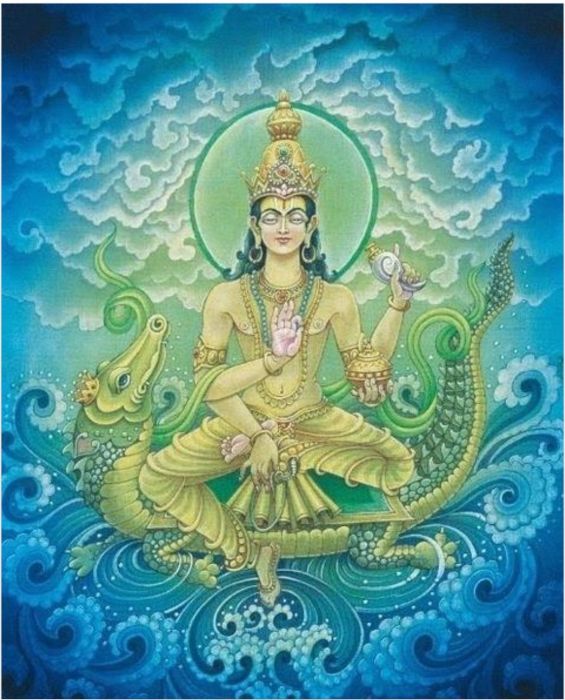
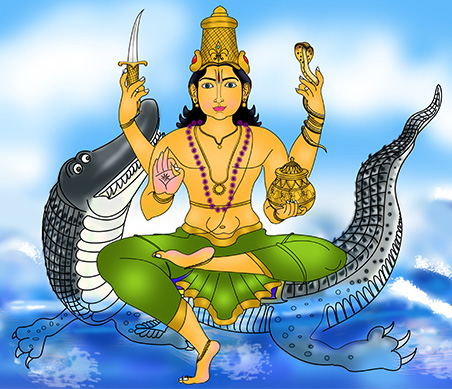
▪︎ Varuna is stated to be the god of the western quarter of our world and universe, but this quarter is founded on water and dependent ultimately on the heart and the fire of soul. He is in charge of the inner world and spiritual development. Similarly, the higher Mind is in charge of the inner world where the lower self evolves. He is the human Soul, and shines down on the lower self like the sun. Varuna is associated with the higher spheres – the western sky and the western portion of the universe, but also with the night, oceans and water which symbolise the moving consciousness of the lower self – sometimes going up towards the Light, the Atma (the dynamic ocean), sometimes down towards to the still (dead) waters of desire, in the material world of maya – the pond or lake.
▪︎ Varuna is also the Lord of Ṛta (justice) and Truth, ie. one of the four great Karmic deities placed at the four cardinal points to watch over mankind. He sees to it that God’s law – the law of karma is carried out. In the same way, the higher Mind is in charge of carrying out this law: it stores all good deeds and thoughts permanently, since they contribute to the spiritual development of consciousness. The seeds of karma (good and bad) from thoughts and deeds are kept by the higher Mind and are restored to the new lower self in each life, so you reap what you sow – there is no injustice.
▪︎ Just as Varuna helped Rama build a bridge to cross over to Lanka, He, as the higher Mind, can also help the lower self in the building of the bridge between them. However, it is the heart which makes this possible, through the growth of consciousness.
● Sudarshana Chakra, the wisdom and power of the heart
▪︎ The Sudarshana Chakra is a special weapon used by Lord Vishnu. It is a spinning, disc-like weapon and has 108 serrated edges. The Heart Chakra is believed to have 108 focal energy lines that extend from the chest (where the Heart Chakra is located) outwards to fill our entire being.
▪︎ So the Sudarshana Chakra is disc-like and spins, like the chakras of the body. In ancient scriptures the centre of the heart was called the crossroad (of energies), and was represented by an equilateral cross. All energies from the Higher consciousness and the Higher world go through the heart to the lower self; all prayers and communication from the lower self to the Higher consciousness, and Higher world go through the heart. The double dorje, like the swastika, indicated the rotation of the heart’s fire. Rotation and equilaterality are the signs of balance.
▪︎ Like the heart, this weapon is wise, and sure, as its name indicates – in fact, the literal meaning of Sudarshana Chakra is “one that has auspicious vision.” Once it is released, the Sudarshana Chakra annihilates the enemy and returns to the one who wielded it. Even after its release, the Sudarshana Chakra remains in complete control of the one who had wielded it, like the heart.
▪︎ The Sudarshana Chakra has the power to destroy anything in its path. So does a spiritually developped heart.
▪︎ It is not thrown, but with willpower it is sent against the enemy. This is because, as the Bhagavad Gita tells us, our enemies are different features of the lower self which tend to keep us bogged down in the material world. In the same way the heart cuts away all negativity as one advances along the Path. Here willpower is needed, and that is why in another tale, Vishnu solicits Shiva’s help to obtain the suitable weapon to defeat the weaknesses of the lower self, for Shiva has great willpower, and He is given the Sudarshana Chakra. The heart also gets its willpower from the Atma as the disciple develops.
▪︎ The Heart is the centre of Spiritual Consciousness. But this Spiritual Consciousness cannot be guided by a person, nor can its energy be directed by him, until he has completely realized the Self. Until then, it guides him – if it can. That is, makes efforts to reach him, to impress the lower consciousness, and those efforts are helped by his growth in purity. Hence the pangs of remorse for wrong done, the prickings of Conscience, reproaching for evil, inciting to good. These come from the Heart. It is through cultivating the qualities of the heart, following its promptings that one can grow spiritually. The heart is greatly purified by higher thoughts.
● Mount Trikuta symbolizes levels of consciousness
▪︎ Trikuta is one of the twenty mountains surrounding Maha Meru (Mount Meru) the home of Brahma. As Brahma created the world, He is in it, and everything is in Him. This symbolizes the fact that Gajendra the disciple is now in the ordinary world, he is no longer in the divine realm, the spiritual paradise with God. To find that realm he has to climb up the mountain to where the gods live. His lower consciousness is now at home in the everyday life of the world.
It is the world of maya because although he is living the life of the lower self, in reality he is the Atma or the higher Self projected into the world of Man. The only reality for him, therefore, is the reality of the Atma, and not that of the lower self.
What is expected of him is to allow himself to be guided by the spiritual impulsions from his higher consciousness by living through the heart, which will steer him through all the necessary experiences, and then make him live permanently as the higher Self or Atma. The Atma will then be able to fully function as God in Man – with a suitable body, or without one, according to the circumstances.
As an example, we can take the case of well-known Masters like Rama and Krishna who, after having realized their True nature long, long ago, come back to Earth through Avatars (who are necessarily Realized beings themselves) whenever necessary, to do God’s work. And today, more and more we come to know of Realized people who, having obtained eternal life through Self / God realization not very long ago, choose to reincarnate to carry out some particular task. There are more people in this case than one would imagine.
▪︎ The Trikuta mountain is believed to be the second home of the goddess Durga. In three different forms, she fought a spiritual battle there to put an end to evil on the earth, and that battle has still not ended. It is on this mountain that Gajendra will fight his own battle, a fitting place.
▪︎ The three peaks symbolize three steps up the ladder of initiation, or three important stages he will go through on the Path back to God.
▪︎ Rtumat garden
▪︎ The mountain has not only a high spiritual realm with three peaks, but also gardens with lakes and animals. The Rtumat garden was created by Varuna (higher Mind) in his role as Lord of Karma and it is adapted to the karmic situation Gajandra (lower self) finds himself in. It symbolizes the material world or kshetra – the “field” referring to the lower consciousness, or lower self; for just as God is the Knower of the field (the world, His playground), in the same way the higher consciousness is the knower of the field (the lower self). In Trikuta, Gajendra, the lower mind, has the choice, for example, to climb the mountains of spirituality and see himself as the knower, or descend to the lakes of illusion and go to the muddy waters of egoism and pleasure through the senses. To avoid the dangers inherent in the life of the lower self, he needs the wisdom of the heart, leading to more light from the soul.
The disciple can win the battle only if he sees himself as the master of the field, one who knows it, and so knows how to proceed, with determination.
● The lake
(or pond) symbolizes the sea of emotions in which we constantly bathe, that constantly pushes our consciousness from one extreme to the other: sad / happy, etc., but which can be transmuted into spiritual love, the energy of love; and the material world with all its egoism and sensual pleasures – i.e. getting pleasure from the physical world and taking the time to indulge in the senses, which hold us captive and bind us in the waters of samsara (perpetual death-rebirth). It is this “field” of desire that the lower self, by seeing itself as the higher consciousness, will have to overcome.
● The Elephant
symbolizes an intelligent and spiritual person, well respected and loved by the community. However, his huge cumbersome animal body tells us that he is no longer adapted to “heavenly” life. Gajendra, the lower self will have to refine his physical and subtle bodies through regular sadhana (spiritual practice), adapted to the goals he has in sight. This is, for example, necessary in order to hear the whispers of the Soul.
▪︎ The herd of elephants
that he is in charge of symbolises different features of the lower self which need to be canalized, “trained” to go in the right direction and follow the path that he leads them on. These features will fall into line when certain spiritual habits are well established. For example, Ma Anandamayi recommends “a fixed time for prayer or meditation for all members of the family including the servants. If this practice is continued for long, divine contemplation will become a part of your nature. Once the habit is established, the future course of your life will be made quite easy. You will feel the flow of the mysterious Divine Grace feeding all your thoughts and giving you new strength.”
That is why Lord Krishna tells the disciple Arjuna how important it is to know himself to be the “knower” (the higher consciousness) of the lower self (the field) so he can win the struggle in the spiritual war between wisdom and ignorance, the psychological combat between higher intelligence and the lower mind, and the bodily war between self-control and harmful self-indulgence. “Know Myself to be the kshetrajna (knower of field) in all the kshetras (fields), O descendant of Bharata. It is the knowledge of kshetra and kshetrajna which I consider as the ultimate knowledge.” (Bhagavad Gita ch.13)
● Lotus flowers, the spiritual gains of the lower self
▪︎ These spiritual gains, produced in each lifetime are stored in the higher consciousness and they become “building blocks” in each life to consolidate the building of a new Man. That is why Gajendra, the lower self offers them to Vishnu. They are obtained by following the promptings of the heart, as symbolized by the lotus flower.
● Makara
▪︎ It is Ahamkara, the I-making faculty of the lower self, the will to be separate, which is necessary for human evolution. However, it must remain subordinate to the will of the higher Mind, which knows itself to be a part of the Universal Mind, where only Unity reigns – everything is connected. This faculty also allows the consciousness to go upwards to the higher Self or down to the materialistic world — the pond or lake of egoism and desire.
🔴 🔴 🔴🔴 🔴 🔴 🔴
THE MEANING OF THE TALE
Gajendra the Disciple’s Duty
After having lived in the heavenly realms, where he was guided by his higher Self, the disciple now finds himself in an inferior situation. He has allowed his consciousness to gravitate towards a very materialistic way of life and as a result, he is now more influenced by the lower mind than the higher one. Maya has made his life as the lower self so real that he is happy with his situation. However, his task in this life is to strengthen his link with the Divine, and live as the higher Self once more so as to reach his spiritual goals. The immortal destiny of each and all of us is to live with the consciousness of the higher Self.
Fortunately, although the influence of the Atma has greatly diminished, the disciple still hears, more and more, the little voice of conscience from his heart, as he reflects on the life he is living. While the thread from the Atma had always been there, there had been no need to build it, the thread between the two minds has to be built by the lower manas. All his lotuses contribute to building this canal through which the two minds can communicate, and to get them, he has to live through his heart.
The thread which links the Soul to the personality will get thicker and thicker as he follows a sadhana. Indeed, all the good thoughts, words and deeds from all his past and present lives are stored by the Soul, which contribute to reinforcing the link between the two selves. Through it, Gajendra will begin to register the Soul’s wisdom as it subtly shapes thoughts within his mind.
This link is the beginning of a canal or bridge between the Soul and the lower mind. Gajendra does not know, but when the first strand of the bridge was built, it meant that he had taken his first step on the Path.
It has been said that to find the Path one must become the Path. This is a profound notion, and directly relates to the subject at hand. Often people believe that the spiritual Path is related to the things we do and the directional choices we make in life. The Path is not a journey based upon doing, but rather upon being. It is not governed by personality driven activity, but by an urge to be the authentic-self, filled with love and guided by wisdom and higher purpose from the heart. In truth, the Path is an inner journey leading to the Soul. This, Gajendra will learn the hard way.
Not Enough Spiritual Progress
The fact that he keeps on going to the lake shows a lack of spiritual aspiration, for that means he likes the worldly life he finds there, which makes him happy; he does not seem to go up to the mountains, to spirituality. However, the disciple does do some good deeds, for he always has flowers to offer Vishnu. But this is not enough to help him out of his situation.
The disciple tells himself that the lake is beautiful, and so he must enjoy it, and he does. However in several versions of the tale, after having been told that the disciple had gone to a lake, at the end, after the disaster, we are told that it was a muddy pond, after all. But that shows a lack of discernment because he has not learnt enough lessons from his past lives to allow him to avoid certain things which are dangerous for his spiritual life. He will have to learn the hard way that all that glitters is not gold.
The fact is that with the veil of maya enveloping his consciousness he does not feel that there is a problem and so does not try to change; he does not remember his past lives as a highly spiritual person, close to God. However, in Varuna’s garden, the law of karma has to be applied, and so circumstances will arise to open the disciple’s eyes to his situation. It is the disciple himself who creates these circumstances by his actions, and not Varuna; the law of karma simply applies to the disciple that which he himself had created before.
At the beginning of this episode, we see that the disciple is submerged by his lower self dominated by maya. He is at the mercy of certain features of this self which may sweep him into inertia, spiritual blindness or bondage, or all three. He is losing the battle between wisdom and ignorance, and maybe also between self control and harmful self-indulgence. He does not remember that in reality he is divine, and should live as the higher Self, as was intended, and we see no signs that he follows a regular sadhana. He does not follow the little voice of conscience.
Disaster Strikes
Then one day, due to his lack of regular sadhana, this worldly living creates a disaster in the disciple’s life. He is caught by bad habits of the lower self, in thinking or behaviour which paralyse, bind him. This had been going on for so long, that they have now overwhelmed him.
The Situation Worsens
Although he tries and tries to get out of that situation, he is held fast. It had taken this situation several lives to come about, as his consciousness had bathed constantly in the waters of desire. Gajendra remains a hostage of those bad habits for a long time, constantly suffering, without applying any of the spiritual teachings or mantras he used to know.
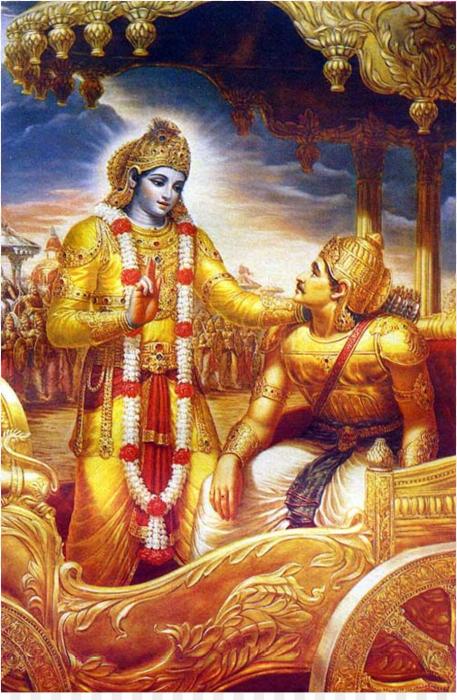
The Disciple Finally Does His Sadhana Earnestly
Varuna, the Soul constantly speaks to Gajendra, but he does not perceive this. But little by little, his heart makes him remember a mantra he used to chant, the name of God. He finds himself chanting it, more and more as time goes by. He notices that he feels less pain when he chants it constantly, but the pain comes back when he stops.
Then parts of the Bhagavad Gita would come to mind, like this one:
Surrender then thy actions unto Me, live in Me, concentrate thine intellect on Me, and think always of Me.
Fix but thy mind on Me, and by My grace thou shalt overcome the obstacles in thy path. But if, misled by pride, thou wilt not listen, then indeed thou shalt be lost.
If thou in thy vanity thinkest of avoiding this fight, thy will shall not be fulfilled, for Nature herself will compel thee.
O Arjuna! Thy duty binds thee. From thine own nature has it arisen, and that which in thy delusion thou desire not to do, that very thing thou shalt do. Thou art helpless.
God dwells in the hearts of all beings, O Arjuna! He causes them to revolve as it were on a wheel by His mystic power.
With all thy strength, fly unto Him and surrender thyself, and by His grace shalt thou attain Supreme Peace and reach the Eternal Home. (Bhagavad Gita, ch.18)
He particularly liked this one, for it seemed to him that it was speaking directly to him. These words were constantly in his mind, and they became a part of him. They brought hope and peace. He would often close his eyes and imagine himself face to face with Vishnu, and His image stayed in his mind all day. He found himself meditating often, then regularly. It felt so good to bathe in such high vibrations that he didn’t feel the crocodile’s bite as much as before.
Since God dwells in his heart, then he could reach Him through prayer, or even just talk to him like a friend. Gajendra often talked to Him, and expressed gratitude. He also prayed for the well-being of others around him, and thanked God for all he had given to the beings on the Earth. He was beginning to live through the heart. He was in a beautiful garden, and he tried to imagine what the mountains were like, and sometimes dreamt that he climbed up to the summit.
Guided by his heart, he slowly got to know himself, he understood his weaknesses better and better. With time, he was no longer frightened by his situation, and he decided to fight the battle and overcome these weaknesses. As he had all the time in the world to think, he often reflected on passages from the holy scriptures, symbolic stories he used to read, and even the ordinary events of his daily life. It seemed to him that everything that had happened to him held a lesson for him to learn, and he would reflect on them. He now understood the usefulness of meditating, selfless service, the right thinking, and self-control, with the help of the heart. He never stopped chanting the name of God and he kept his mind in a constant state of meditation. He always saw himself with Vishnu in Vishnuloka (Vaikuntha).
The disciple was now able to understand his situation, for guided by the heart, the spiritual practices he had adopted strengthened the bridge between the Soul and the lower mind, thus enabling him to receive answers to his questioning, advice about things in his everyday life, and explanations about many spiritual concepts. More and more light was coming down from the Soul, and his knowledge became wisdom. He understood that only Vishnu could save him from spiritual death, which was threatening him. He surrendered to Him.
The Soul, seeing that the lower self was seriously building a bridge in His direction, started building the other end of the bridge. Yes, they were both working together. Then Makara was subdued.
From that day on, his heart exulted. His consciousness had become transformed little by little, and now he was much different from the Gajendra he used to be. It was not only his thoughts which had become refined, but also his physical and subtle bodies. He continued his sadhana and it made him happy, he did not feel time pass as he constantly prayed to Vishnu and chanted His name.
One day, he wondered what the herd was doing, and he immediately knew in his heart that they were walking in the woods. He now possessed a small part of Varuna’s vast knowledge and wisdom ! It had inundated his consciousness and enlightened it !
Indeed, the bridge was finished, he was now once more in the divine world. All the prayers and meditation he had done had invoked the energies of the higher Self (Vishnu), through the heart, which had sent enough willpower for the disciple to be steadfast in his sadhana, in his determination to reach God. This willpower, sent to the heart (sudarshana chakra) had cut all ties with the the lower self (Makara decapitated), as the bridge was completed. He had obtained Moksha (no rebirth is necessary).
In Part 1 the tale puts it this way:
[…] and with Vishnu’s help, Gajendra achievies moksha, or liberation from the cycle of birth and death [eternal life]. Gajendra then attaines a form like that of the deity (Sarupya Mukti) and goes to Vaikuntha with Vishnu. Vaikuntha, also called Vishnuloka is the abode of Vishnu. It is an “eternal heavenly realm”, and is the “divine imperishable world that is God’s abode”.
The tale also tells us that “He (Vishnu), made him understand the concept of Kaivalya, which was beyond Svarga (Indraloka) and Urdhva Loka, the realm of the gods.”
The Yogatattva Upanishad (16–18) reads,
Kaivalya is the very nature of the SELF, the supreme state (paramam padam). It is without parts and is stainless. It is Truth-Consciousness-Bliss (Sat-Chit-Ananda). it is devoid of birth, existence, destruction, recognition, and experience.
This means that with the help of Atma (Vishnu), he then climbed the other two peaks of the mountain and completely changed his consciousness. Gajendra was now a Divine Man with the consciousness of the Atma, God. He had realized the SELF, God. He would henceforth help God in His work.
A FEW REMARKS
We all know of realized Masters who are Gurus, but we know less of others who do other work. Some do both at the same time. Many realized souls have vowed to stay with Earth and work for the spiritual progress and well-being of ALL sentient beings. Whether incarnated or not, they continue to inspire humanity (which is One Body – we share the same Universal Soul) to make the right choices as we go up the path of spirituality. The evolution of all four kingdoms (mineral, plant, animal and human) happens at the same time, and when humanity rises in the spiral of evolution, this helps the other kingdoms up the ladder also. (That is the reason behind ahimsa – not harming anything in God’s creation.) They also inspire humanity to care for these lower kingdoms.
Among us today, there are great incarnated beings, called by different names, like Masters, Masters of Wisdom, Cosmic Masters, Bodhisattvas, who discreetly give assistance to humanity. They have not left Earth, while others in the same category have, and carry out their work without being incarnated. As an example of a part of their work – at particular times, they may receive God’s energy from the planets and constellations and redistribute it to humanity as needed, as these energies may need to be toned down. Others work through Avatars for specific tasks. They know the different cycles through which humanity and the planet in general evolve, and when it is time, they prepare humanity as best they can to meet the requirements and more easily go through those changes which will come about. However, they cannot help humanity against their will, and they always follow God’s law. This is just a part of their work. We are very grateful for their assistance.
🔴 🔴 🔴🔴 🔴 🔴 🔴


 The Call of the Heart