
Introduction
This tale is about a disciple who finds himself in great spiritual difficulty, but succeeds in overcoming the obstacles. There are many versions of this story but they are quite similar. We are hardly given any details, but with the help of the symbolism made clear, we understand more easily the depths of his inner struggle to reach the light. We are told that spiritual stories have three meanings (Bhagavad Gita), or more, so we have tried to go beyond the apparent meaning to discover a deeper one. Our subconscious mind, which recognizes certain truths in these tales may present each person with different meanings to the symbols, depending (among other things) on their interest, sincerity and state of consciousness at a particular time. There is not One fixed meaning to them.
There are many tales in Hinduism about the relationship between Man and the Divinity, or about the disciple’s trials in life as he seeks to get close to the Divinity, and they give some advice on how to become one with God. However, if one does not understand the symbols used in these allegories, the truths remain superficial, and the inner meaning of these stories is not perceived.
The characters used are usually very well known (to Hindus), so that their qualities and weaknesses do not need to be explained in detail. That is why very often God (Shiva, Vishnu, Brahma, their Avatars and consorts), demi-gods, devas, important spiritual beings, even though they are almost always made to act like human beings, which we know they never do, play a prominent role. Sages, places, bodies of water (lakes, rivers, oceans) are also often used, along with well known animals which are chosen for their known characteristics, but also because they are used as symbols for spiritual truths.
In general, one can say that tales have always been used, ever since man existed, to show him these spiritual truths in a way that will be more easily perceived by the subconscious mind of the lower self, which will retain the symbols and images and associate them with those truths. And when the same characters – people, animals etc appear tale after tale, the reader / listener more easily sees himself in the same situation, or not, and his heart whispers to him, showing him the right path to take in each situation. Reflection on these stories is very good for developing the abstract mind, one of the pillars on the path to Enlightenment.
In this article, we will start the study of the story Gajendra Moksha, and try to find out the deep meaning of the tale. We will set out the symbols and their meaning, then explain the story according to the deep symbolism found. The study will be in two parts : Gajendra Moksha – Part 1: Indradyumna’s Disgrace, and Gajendra Moksha – Part 2 : Indradyumna-Gajendra Attains Moksha.
🔴 🔴 🔴🔴 🔴 🔴 🔴
A Summary of The Tale
Gajendra Mokṣaḥ or The Liberation of Gajendra is a Puranic legend from the 8th Skandha of the Bhāgavata Purāṇa, a sacred text in Hinduism. It is one of the famous exploits of the preserver deity, Vishnu.
In this episode, Vishnu comes down to Earth to protect Gajendra, the elephant, from the clutches of a crocodile, alternatively known as Makara or Huhu, and with Vishnu’s help, Gajendra achievies moksha, or liberation from the cycle of birth and death [eternal life]. Gajendra then attaines a form like that of the deity (Sarupya Mukti) and goes to Vaikuntha with Vishnu. Vaikuntha, also called Vishnuloka is the abode of Vishnu. It is an “eternal heavenly realm”, and is the “divine imperishable world that is God’s abode”.
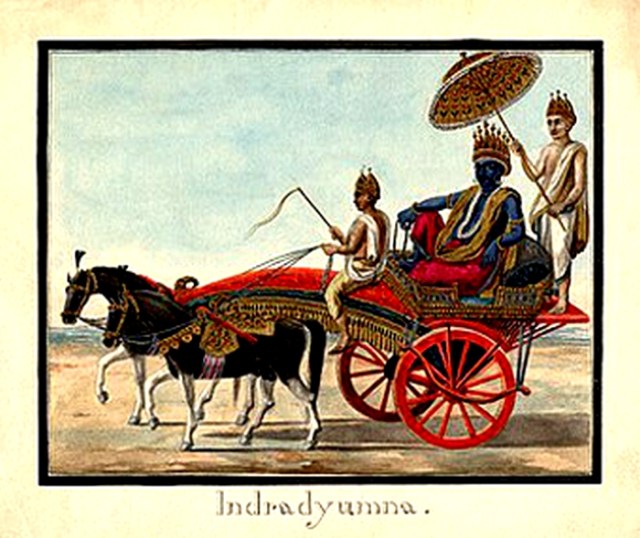
Gajendra, in his previous life, had been Indradyumna, a great king who was devoted to Vishnu. One day, Agastya, a great rishi (sage) came to visit the king, but Indradyumna remained seated, refusing to rise to receive the sage with due respect. Agastya was irate and noticed that the mighty king, despite the greatness of his good deeds, still had traces of ahamkara, or egoism, and he revealed to the king that, in his next birth, he would be born as an elephant, and in that form he would learn the hard way that the lower self must be renounced and surrendered to God. SymbolismThe tale of Gajendra is an integral theme in Vaishnavism and has great symbolic value: Gajendra is Man, the crocodile is sin, and the muddy water of the lake is Saṃsāra (almost unending cycle of death and rebirth). The symbolic meaning of Gajendra Moksha is that materialistic desires, ignorance, and sins create an endless chain of karma in this world and are similar to a crocodile preying upon a helpless elephant stuck in a muddy pond. Humans are thus stuck in a continuous cycle of death and rebirth until the day when they can look beyond everything in this creation and ultimately submit themselves to the supreme being, Vishnu. (Adapted from Gajendra Moksha. Read the rest of the tale here)
🔴 🔴 🔴🔴 🔴 🔴 🔴
PART 1: Indradyumna’s Disgrace
The Symbols
● Vishnu
Vishnu is God, Creator of all that is. Everything is contained in Him, and He is in everything. Vishnu is also the spark of God in man (usually known as Brahman) – the Atma, the higher Self, which was not created, is divine and eternal. The Atma – God in man – remains in God and can never leave.
▪︎ The aim of the Atma is to develop fully into a spiritual Man and then help God in his work.
For this, He uses his Thread of Light to guide the lower self throughout the different lives he lives, so that the spiritual gains of the lower self will one day lead to the union of the lower consciousness with the higher consciousness. This will result in the emergence of a new Man, a Spiritual Man, divine in nature and ruled directly by God, the Atma.
● King Indradyumna, the lower self
Although he does not realize it, Indradyumna, as the lower self is closely connected to Vishnu the higher Self – God in man. In fact, he is one with the Atma, he is the Atma “made flesh”. He is meant to live in the higher spheres, as his status as a king indicates, as well as the meaning of his name: “One with the splendour like that of Indra”.
His free will allows him to keep his consciousness on the higher planes, or let it descend to the easy life of a materialistic world. It is this battle that the disciple has to win in order to understand that he is one with his Father, the Atma, and that his purpose is to serve Him; he will find no peace until he lives as He directs him to.
● Agastya, the Thread of Light
▪︎ He plays the role of the Thread of Light which the Atma uses, through the Universal Soul (Buddhi) to vivify and guide his shadow or son, from the highest level of consciousness to the low planes of the shadow in the physical world.
▪︎ He also represents the higher planes of consciousness in general.
▪︎ Agastya carries all the impulses and messages from the higher consciousness down to the lower self; Indradyumna feels and hears them through the little voice of conscience in his heart. He can choose to follow them or ignore them.
🔴 🔴 🔴🔴 🔴 🔴 🔴
THE MEANING OF THE STORY
Indradyumna, The Lower Self Lives a Happy Life
We notice that the disciple of Vishnu, King Indradyumna is in a very comfortable position and is happy in life. This means that he is spiritually rich.
The initial situation is one of a disciple on the path, and at this stage, he is one with the Atma. As the lower self, or the lower mind, he rules over his subjects such as his five senses and his different states of consciousness where he can turn his mind upwards towards a high state of consciousness through love, kind thoughts, sharing, selfless works etc., or he can follow the easier downward path of a purely materialistic life of selfish behaviour, ephemeral pleasures and seeing himself as separate from other beings. The capacity to choose between the two worlds is conferred to him through the element Makara in Man.
He is considered a good disciple for he is devoted to God, and is known for the greatness of his good deeds. His consciousness remains on the higher planes of his being. This allows him to continue to benefit from the divine Light and guidance of his higher Self, his Atma (God, God in Man) symbolized by Vishnu, which comes directly to him through Agastya, the divine Thread which the Atma uses to guide him.
Since God, his father comes directly to the disciple, through the Thread, there is no need for pilgrimages or any sacrifices to get God’s favour. Divine blessings automatically flow freely down to the lower self, Indradyumna. This divine river flows freely down to the lower self because the Atma had the latter created to do specific work for it. All the disciple has to do is to keep his mind on God and the higher spheres while living his daily life, follow a simple sadhana and follow the impulses he gets in return. In that way the canal between the two selves remains open.
This is the state of Man when he is in his early development and is still mostly a spiritual being in which duality has not yet greatly developed and the fight between the higher Self and the lower one has not gone very far; it is still to the advantage of the Atma. Indeed, the body in which the Atma’s Thread is housed is still simple and spiritual, with not too much matter, which allows God’s spiritual energy to flow freely throughout his being. The disciple’s consciousness therefore remains naturally in the heavenly realms (connected to the Atma). He is in a sort of spiritual paradise.
Through the similarity of the names Indra, Indradyumna, and Indraloka we sense the deep connection between the lower self and the divine world. Indeed, The lower self is just a projection of the higher Self on a lower plane. He is spiritually in the divine world, but his lower mind tells him the opposite; however the more he turns his mind to the heights of spirituality, the more the divine world becomes real and normal.
Harmony Is Broken, A Problem Arises
But this situation changes dramatically when the disciple shows great disrespect for the usual instructions and advice (spiritual nourishment) coming from his higher consciousness through Agastya, the divine Thread. The disciple does not react as he should. When he feeels the impulsions from his higher consciousness, he sometimes ignores them, or doubts that it is the voice of God that he hears. Finally he no longer sees or feels the light coming from the Thread, and so does not follow the instructions given. He is blinded by the development of maya which accompanies the development of the lower self. The term maya has been translated as ‘illusion,’ but then it does not concern normal illusion. Maya means that the world is not as it seems; the world that one experiences is misleading as far as its true nature is concerned. Our true nature is that of the Atma, which is Truth-Consciousness-Bliss.
So, unfortunately, as time had gone by, after many, many, many lives the influence of the Atma’s Thread had become covered by the thicker and thicker layers of the lower self’s bodies as they became more and more complex; and also the development of the five senses, not connected to the higher Self, had caused the disciple’s lower self to live in a new artificial world of maya where the pursuit of artificial happiness, selfishly, had became the aim of life. Ahamkara, the I-making faculty in Man conferred by Makara had become too strong and had taken over. And Agastya did not fail to notice these traces of egoism – the will to be separate.
Progressively, the king felt less and less the influence of the Thread, but did not react enough. Although he loved Vishnu he did not use his spiritual faculties to push his consciousness upwards, but focused his attention on what the lower self found important, and lost his good spiritual habits; he was, perhaps, satisfied with doing a quick prayer from time to time, and going to the temple for the usual festivals. But unfortunately this was not enough, and so as nothing remains static, his consciousness gradually went downwards to a more materialistic way of life. His devotion to Lord Vishnu diminished without him even noticing. That is why, one day, the disciple did not even bother to react to the presence of the Atma’s Thread, Agastya. He no longer recognized the divine impulsions as something important; he was separated from the guiding influence of the Atma – God in Man.
The Situation Worsens
According to God’s law, the law of karma, the disciple had prepared his next life through his thoughts and deeds, and so king Indradyumna has to live accordingly. His vibrations have become far too low for him to remain in a high spiritual sphere. His consciousness is no longer apt to receive the high vibrations of the spiritual energies from the higher Self. By his own behaviour, he has made it impossible for the Atma to guide him, and equally impossible for him to continue to benefit from the blessings that the Atma generally bestows on one who is connected.
Now receiving very little guidance from the Atma, the lower self then has to build a path back to his higher consciousness through a life of trials and suffering. He has to learn the hard way that the lower self is not independent, and that its destiny is to provide the path that the lower consciousness will take to meet the higher consciousness, and to see to it that the bridge between the two is built, otherwise he will live lives of suffering through endless cycles of death-rebirth (samsara).
So in his next life he will find himself in a situation created by only himself, where the circumstances of his new life will be adapted to the world he has created in his lower consciousness.
He will have the help of his heart and the higher Mind, the higher Manas which, with the Atma and Buddhi form the higher consciousness. From time to time he used to get inspiring flashes from this Mind, but that was when he liked to think about God and would often read the holy scriptures, like the Bhagavad Gita. Of late, he had not had any inspiring thoughts, but necessity is the mother of invention, so he will find the path back home.
(Continued in Part 2)
🔴 🔴 🔴🔴 🔴 🔴 🔴


 The Call of the Heart